
|
You entered: Galileo
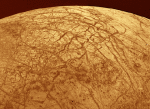 Europa's Surface
13.08.1996
Voyager spacecraft images of Europa's surface, like the one above, are suggestive of sea ice on Earth. The criss-crossing dark streaks may indeed be cracks in its ice-covered surface caused by Jupiter's tidal stresses accompanied by the freezing and expansion of an underlying layer of water.
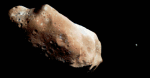 Ida and Dactyl: Asteroid and Moon
30.06.1995
An asteroid with a moon! The robot spacecraft Galileo whose primary mission is to explore the Jupiter system, has encountered and photographed two asteroids during its long journey to Jupiter. The second asteroid...
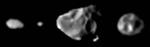 Jupiter's Inner Moons
27.11.1997
The potato-shaped inner moons of Jupiter are lined-up in this mosaic "family portrait" of these tiny Jovian satellites. The individual images were recorded over the last year by NASA's Galileo spacecraft and are scaled to the moons' relative sizes.
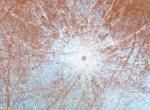 Pwyll: Icy Crater of Europa
17.04.1997
The impact crater Pwyll (a name from Celtic Mythology) is thought to represent one of the youngest features on the surface of Jupiter's moon Europa. A combination of color and high resolution black...
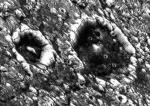 Dark Craters on Ganymede
22.07.1998
Ganymede has craters within craters within craters. The old surface of the largest moon in the Solar System shows its age by the large amount of these impact features. The above picture released last...
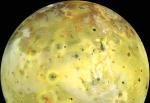 Io in True Color
20.09.1999
The strangest moon in the Solar System is bright yellow. This recently released picture, showing Io's true colors, was taken in July by the Galileo spacecraft currently orbiting Jupiter. Io's colors derive from sulfur and molten silicate rock. The unusual surface of Io is kept very young by its system of active volcanoes.
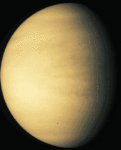 Venus: Earth's Sister Planet
15.08.1995
This picture in visible light was taken by the Galileo spacecraft. Venus is very similar to Earth in size and mass - and so is sometimes referred to as Earth's sister planet - but Venus has a quite different climate.
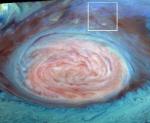 Storm Clouds Over Jupiter
27.11.1996
Storm clouds, similar to the familiar cumulonimbus thunderheads of Earth, appear to be present on Jupiter. The mosaic of images above shows the region near the raging edge of Jupiter's Great Red Spot, itself some 2 to 3 Earths wide, as observed by the Galileo spacecraft in June of this year.
 Io: The Prometheus Plume
18.08.1997
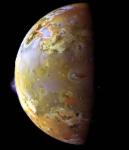
Two sulfurous eruptions are visible on Jupiter's volcanic moon Io in this color composite Galileo image. On the left, over Io's limb, a new bluish plume rises about 86 miles above the surface of a volcanic caldera known as Pillan Patera.
 Io in True Color
3.10.2010
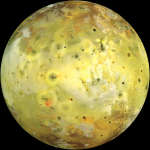
The strangest moon in the Solar System is bright yellow. This picture, an attempt to show how Io would appear in the "true colors" perceptible to the average human eye, was taken in 1999 July by the Galileo spacecraft that orbited Jupiter from 1995 to 2003.
|
January February March April May June July August September October |
|||||||||||||||||||||||||||||||||||||||||||||||||