
|
You entered: Galileo
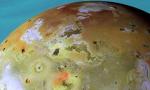 Sizzling Io
6.07.1998
What's cooking on Io? This active moon of Jupiter is marked with volcanoes spewing lava that is now known to be hotter than any lava on Earth. Above is the highest resolution color-enhanced image yet composed of the most active surface in our Solar System. Features as small as three kilometers are visible.
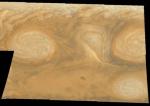 White Oval Clouds on Jupiter
8.08.1997
What are those white ovals all over Jupiter? Storms! Jupiter's clouds can swirl rapidly in raised high-pressure storm systems that circle the planet. The above pictured white ovals are located near the Great Red Spot, and have persisted on Jupiter since the 1930s. The Great Red Spot has persisted for at least 300 years.
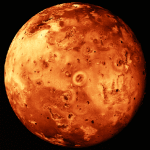 Io: A Volcanic Moon
3.08.1995
In 1610, Galileo turned his telescope to the heavens and discovered that the planet Jupiter had four bright moons. The innermost of these Galilean moons, Io, turned out to be one of the most exotic objects in the solar system.
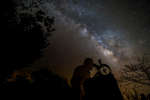 Along the Milky Way
3.07.2021
You can't walk along the Milky Way. Still, under a dark sky you can explore it. To the eye the pale luminous trail of light arcing through the sky on a dark, moonless night does appear to be a path through the heavens.
 Rocket Eclipse at Sunset
28.09.2024
Shockwaves ripple across the glare as a launch eclipses the setting Sun in this exciting close-up. Captured on September 17, the roaring Falcon 9 rocket carried European Galileo L13 navigation satellites to medium Earth orbit after a lift-off from Cape Canaveral on Florida's space coast.
 Cracks and Ridges on Europa
10.03.1998
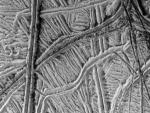
Which way to the interstate? What appears to be a caricature of a complex highway system on Earth is actually a system of ridges and cracks on the icy surface of Jupiter's moon Europa. The distance between parallel ridges in the above photograph is typically about 1 kilometer.
 Mysterious Features on Ganymede
9.12.1997
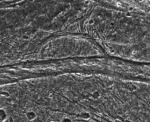
Where is the rest of the circle? Jupiter's largest moon Ganymede has some truly unusual terrain, including the pictured half circle above cut by nearly parallel curves. Full circles can be easily explained by impact craters, but partial circles imply that some resurfacing has occurred since the original impact.
 M44: A Beehive of Stars
3.08.1998
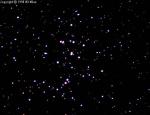
M44 is a prominent open cluster of stars. Nicknamed Praesepe and "The Beehive", it is one of the few open clusters visible to the unaided eye. M44 was thought to be a nebula until Galileo used an early telescope to resolve the cluster's bright blue stars. These stars are visible in the above image.
 Io's Sodium Cloud
28.04.1997
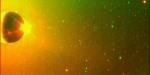
Io has its own cloud. Jupiter's most active moon is visible on the left of the above false-color photograph, with its left side illuminated by sunlight. But what is happening on Io's right side? Here a plume of gas from the active volcano Prometheus also reflects sunlight.
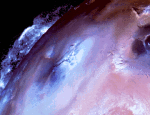 Erupting Volcanoes on Io
5.08.1996
Jupiter's moon Io has active volcanoes. The Voyager spacecraft caught several erupting when they passed the energetic moon in 1979. In the above picture, several of Io's volcanoes are visible and one is seen actually erupting.
|
January February March April May June July August September October |
|||||||||||||||||||||||||||||||||||||||||||||||||