
|
You entered: Galileo
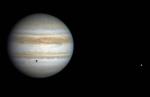 Cassini Spacecraft Approaches Jupiter
11.10.2000
A new spacecraft has entered the outer Solar System: Cassini. Launched in 1997 and bound for Saturn in 2004, Cassini sent back the above image last week while approaching the giant planet Jupiter. Cassini joins the Galileo spacecraft currently in orbit around Jupiter in studying the gas giant and its moons.
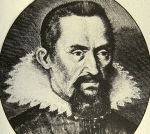 Kepler Discovers How Planets Move
13.09.1997
Johannes Kepler used simple mathematics to describe how planets move. Kepler was an assistant to the most accurate astronomical observer of the time, Tycho Brahe. Kepler was able to use Brahe's data...
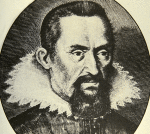 Kepler Discovers How Planets Move
31.08.1996
Johannes Kepler used simple mathematics to describe how planets move. Kepler was an assistant to the most accurate astronomical observer of the time, Tycho Brahe. Kepler was able to use Brahe's data...
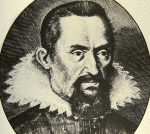 Kepler Discovers How Planets Move
6.06.1999
Johannes Kepler used simple mathematics to describe how planets move. Kepler was an assistant to the most accurate astronomical observer of the time, Tycho Brahe. Kepler was able to use Brahe's data...
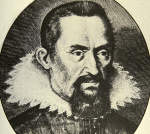 Kepler Discovers How Planets Move
14.01.2001
Johannes Kepler used simple mathematics to describe how planets move. Kepler was an assistant to the most accurate astronomical observer of the time, Tycho Brahe. Kepler was able to use Brahe's data...
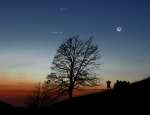 Moon and Planets in the Morning
22.10.2009
Last Friday, a gathering of three bright planets and the Moon graced the morning sky. With Mercury, Venus, Saturn, and a narrow lunar crescent close to the eastern horizon in the dawn twilight, this picture of the beautiful conjunction was recorded near Noerdlingen, Germany.
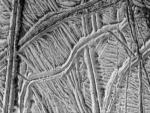 Cracks and Ridges on Europa
2.06.2002
Which way to the interstate? What appears to be a caricature of a complex highway system on Earth is actually a system of ridges and cracks on the icy surface of Jupiter's moon Europa. The distance between parallel ridges in the above photograph is typically about 1 kilometer.
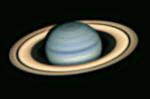 Saturn from Earth
2.09.1998
Saturn is the second largest planet in our Solar System. Saturn has been easily visible in the sky since history has been recorded. Galileo used one of the first telescopes in 1610 to discover Saturn's rings, which he first thought were moons.
 Crossing The Ring Plane
1.08.1995
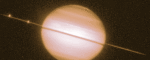
"I do not know what to say in a case so surprising, so unlooked for and so novel." announced Galileo when Saturn's rings appeared to vanish in 1612. In fact, every 15 years Saturn's rings seem to almost disappear as viewed from the Earth.
 A New Year s Crescent
1.01.2014
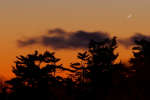
That's not the young crescent Moon poised above the western horizon at sunset. Instead it's Venus in a crescent phase, captured with a long telephoto lens from Quebec City, Canada, planet Earth on a chilly December 30th evening. The very bright celestial beacon is droping lower into the evening twilight every day.
|
January February March April May June July August September October |
|||||||||||||||||||||||||||||||||||||||||||||||||