
|
You entered: Galileo
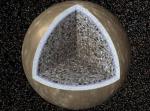 Cutaway Callisto: Ice, Rock, and Ocean
6.11.1998
Cruising past the moons of reigning gas giant Jupiter, Voyager and Galileo have returned tantalizing evidence for a liquid water ocean beneath the surface of Europa. Now researchers are reporting telltale indications that the battered Jovian moon Callisto may also harbor a subsurface
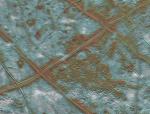 Europa: Ridges and Rafts on a Frozen Moon
10.09.1998
The large Jovian moon Europa may harbor liquid water beneath its frozen crust. Controversy surrounding this idea has been recently fueled by dramatic images of Europa's surface from the Galileo spacecraft. This alluring...
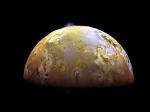 Io: The Prometheus Plume
11.02.2007
What's happening on Jupiter's moon Io? Two sulfurous eruptions are visible on Jupiter's volcanic moon Io in this color composite image from the robotic Galileo spacecraft that orbited Jupiter from 1995 to 2003.
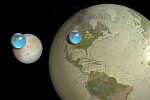 APOD: 2025 October 12 Б All the Water on Europa
12.10.2025
How much of Jupiter's moon Europa is made of water? No one is sure, but probably a lot. Based on the Galileo probe data acquired during its exploration of the Jovian system from 1995 to 2003, Europa possesses a deep, global ocean of liquid water beneath a layer of surface ice.
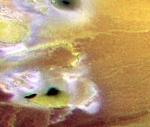 Calderas And Cliffs Near Io's South Pole
27.04.2000
Braving intense radiation belts, the Galileo spacecraft once again flew past the surface of Jupiter's moon Io (sounds like EYE-oh) on February 22. Combining high resolution black and white images from that flyby...
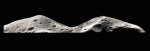 NEAR to an Asteroid
15.02.1996
Excitement mounts as NASA's Near Earth Asteroid Rendezvous (NEAR) spacecraft nears launch - currently scheduled for 3:53 ET on February 16. NEAR's mission is to become the first spacecraft to rendezvous with and orbit an asteroid, the asteroid designated 433 Eros.
 APOD: 2025 April 29 Б Saturns Rings Appear to Disappear
29.04.2025
Where are Saturn's ears? Galileo is credited, in 1610, as the first person to see Saturn's rings. Testing out Lipperhey's recently co-invented telescope, Galileo did not know what they were and so called them "ears". The mystery deepened in 1612, when Saturn's ears mysteriously disappeared.
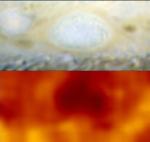 Jupiter: When Storms Collide
22.10.1998
Sometime in February, two of three long-lived Jovian storm systems known as "white ovals" apparently collided and merged -- forming what is now likely the second largest storm in the Solar System, after the famous Great Red Spot.
 Welcome to the International Year of Astronomy
1.01.2009
Astronomers all over planet Earth invite you to experience the night sky as part of the International Year of Astronomy 2009. This year was picked by the International Astronomical Union and the United Nations Educational, Scientific, and Cultural Organization because it occurs 400 years after Galileo turned one of the first telescopes toward the heavens.
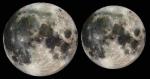 Perigee Moon, Apogee Moon
22.12.1999
Tonight, those blessed with clear skies can enjoy a glorious full moon, the last full moon of the "Y1.9K"s. In fact, tonight's moon will be a full-perigee-solstice moon, reaching its full phase and perigee (the closest point in its orbit) on the solstice, the first day of northern hemisphere winter.
|
January February March April May June July August September October |
|||||||||||||||||||||||||||||||||||||||||||||||||