
|
You entered: Sun
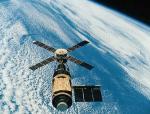 Skylab Over Earth
28.05.2000
Skylab was an orbiting laboratory launched by a Saturn V rocket in May 1973. Skylab was visited three times by NASA astronauts who sometimes stayed as long as two and a half months. Many scientific tests were performed on Skylab, including astronomical observations in ultraviolet and X-ray light.
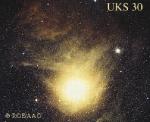 Antares
24.06.1997
Antares is a huge star. In a class called red supergiant, Antares is about 700 times the size of our own Sun, 15 times more massive, and 10,000 times brighter. Antares is the brightest star in the constellation of Scorpius and one of the brighter stars in all the night sky.
 The Night Shift
17.12.1998
For the orbiting International Space Station (ISS), the sun sets every 90 minutes. But working through the night, spacewalking astronauts can rely on artificial lighting. Here, the eerie glow of work-lights illuminate Space Shuttle Endeavor astronaut Jerry Ross during a night on his
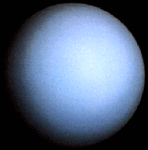 Uranus: The Tilted Planet
16.08.1995
This picture was snapped by the Voyager 2 spacecraft in 1986 - the only spacecraft ever to visit Uranus. Uranus is the third largest planet after Jupiter and Saturn. Uranus has many moons and a ring system.
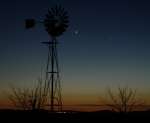 Venus and Mercury in the West
7.04.2010
In this twilight skyview, a windmill stands in silent witness to a lovely pairing of planets in the west. The picture was recorded on April 5 from Gallegos del Campo, Zamora, Spain. Venus (left) and Mercury (right) are near their much anticpated conjunction in the early evening sky.
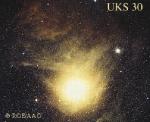 Antares
26.07.1998
Antares is a huge star. In a class called red supergiant, Antares is about 700 times the diameter of our own Sun, 15 times more massive, and 10,000 times brighter. Antares is the brightest star in the constellation of Scorpius and one of the brighter stars in all the night sky.
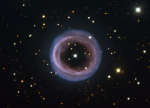 Shapley 1: An Annular Planetary Nebula
16.08.2011
What happens when a star runs out of nuclear fuel? For stars about the mass of our Sun, the center condenses into a white dwarf while the outer atmospheric layers are expelled into space and appear as a planetary nebula.
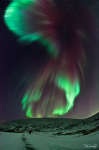 A Memorable Aurora Over Norway
5.12.2011
It was one of the most memorable auroras of the season. There was green light, red light, and sometimes a mixture of the two. There were multiple rays, distinct curtains, and even an auroral corona. It took up so much of the sky.
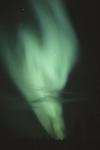 Aurora in the Night
31.10.2002
For much of the month of October, traveling shock waves from the Sun and solar wind gusts have buffeted planet Earth's magnetosphere. As a result, skywatchers at high latitudes in the northern hemisphere were treated to many displays of the aurora borealis or northern lights.
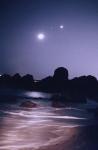 A Laguna Triangle
18.05.1999
High above Laguna Beach last month hung bright celestial orbs. Visible after the California sunset were, from left to right, the Moon, Saturn, and Venus. Tonight and for the next few days, Venus and the Moon will again be visible together. Nearby stars will include Pollux, Castor, and Procyon.
|
January February March April May June July August September October |
|||||||||||||||||||||||||||||||||||||||||||||||||