
|
You entered: Sun
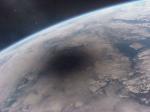 Looking Back on an Eclipsed Earth
26.09.2004
Here is what the Earth looks like during a solar eclipse. The shadow of the Moon can be seen darkening part of Earth. This shadow moved across the Earth at nearly 2000 kilometers per hour.
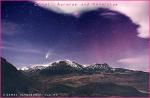 Big Sky Comet
21.04.1997
On April 17th, "Big Sky" country sure lived up to its name. The dark skies over the US states of Wyoming, Montana and the Dakotas were quite busy, as shown by this photograph featuring Comet Hale-Bopp. In the foreground is the Absaroka Mountain Range in Wyoming, lit by reflected moonlight.
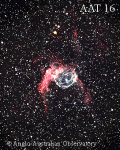 A Wolf Rayet Star Bubble
28.09.1997
What's a Wolf-Rayet star, and how did it create that spherical bubble and sweeping arc? A Wolf-Rayet star is a star that originated with a mass over 40 times that of our Sun.
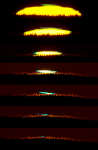 Northern Green Flash
23.06.2012
As seen from Frösön island in northern Sweden the Sun did set a day after the summer solstice. From that location below the arctic circle it settled slowly behind the northern horizon.
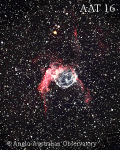 A Wolf-Rayet Star Bubble
26.08.1996
What's a Wolf-Rayet star, and how did it create that spherical bubble and sweeping arc? A Wolf-Rayet star is a star that originated with a mass over 40 times that of our Sun.
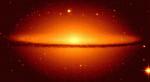 M104: The Sombrero Galaxy
8.02.1997
The famous Sombrero galaxy (M104) is a bright nearby spiral galaxy. The prominent dust lane and halo of stars and globular clusters give this galaxy its name. Something very energetic is going on in the Sombrero's center, as much X-ray light has been detected from it.
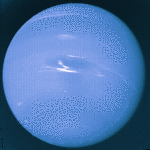 Neptune: Big Blue Giant
21.02.1998
This picture was taken by the Voyager 2 spacecraft in 1989 - the only spacecraft ever to visit Neptune. Neptune will be the farthest planet from the Sun until 1999, when the elliptical orbit of Pluto will cause it to once again resume this status.
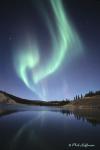 Dueling Auroras
7.08.2005
Will it be curtains for one of these auroras? A quick inspection indicates that it is curtains for both, as the designation "curtains" well categorizes the type of aurora pattern pictured. Another (informal) type is the corona.
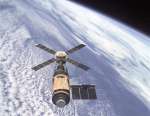 Skylab Over Earth
18.08.2013
Skylab was an orbiting laboratory launched by a Saturn V rocket in May 1973. Skylab, pictured above, was visited three times by NASA astronauts who sometimes stayed as long as two and a half months. Many scientific tests were performed on Skylab, including astronomical observations in ultraviolet and X-ray light.
 Rocket Eclipse at Sunset
28.09.2024
Shockwaves ripple across the glare as a launch eclipses the setting Sun in this exciting close-up. Captured on September 17, the roaring Falcon 9 rocket carried European Galileo L13 navigation satellites to medium Earth orbit after a lift-off from Cape Canaveral on Florida's space coast.
|
January February March April May June July August September October |
|||||||||||||||||||||||||||||||||||||||||||||||||