
|
You entered: Sun
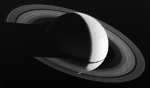 Looking Down on Saturn
21.09.1997
This picture of Saturn could not have been taken from Earth. No Earth based picture could possibly view the night side of Saturn and the corresponding shadow cast across Saturn's rings. Since Earth is much closer to the Sun than Saturn, only the day side of the planet is visible from the Earth.
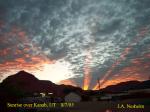 Crepuscular Rays Over Utah
31.08.2005
What could cause such rays of dark? Dark sky rays were caught in spectacular fashion earlier this month above Utah, USA. The cause is something surprisingly familiar: shadows. Clouds near the horizon can block sunlight from reflecting off air, making columns outward from the Sun appear unusually dark.
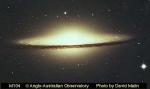 M104: The Sombrero Galaxy
23.02.1998
What's going on in the center of this spiral galaxy? Named the Sombrero Galaxy for its hat-like resemblance, M104 features a prominent dust lane and a bright halo of stars and globular clusters.
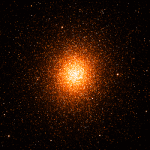 Millions of Stars in Omega Centauri
21.02.1996
Pictured above is the largest ball of stars in our Galaxy. About 10 million stars orbit the center of this globular cluster - named Omega Centauri - as this giant globular cluster orbits the center of our Galaxy.
 McNaught Now Brightest Comet in Decades
9.01.2007
The brightest comet in decades is unexpectedly now visible. The most optimistic predictions have Comet McNaught (C/2006 P1) shortly becoming one of the brightest comets of the past century. For the next few days...
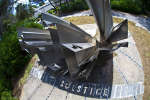 A Sundial that Shows Solstice
21.06.2017
What day is it? If the day -- and time -- are right, this sundial will tell you: SOLSTICE. Only then will our Sun be located just right for sunlight to stream through openings and spell out the term for the longest and shortest days of the year. But this will happen today (and again in December).
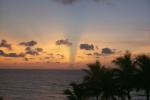 A Cloud Shadow Sunrise
27.02.2002
What could cause a ray of dark? Such a ray was caught in spectacular fashion above the Florida Everglades two years ago. The cause is something surprisingly familiar: a shadow. The gold-tinged cloud near the horizon blocks sunlight from reflecting off air behind the cloud, making that column of air appear unusually dark.
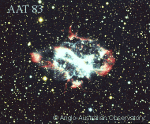 NGC 5189: A Strange Planetary Nebula
11.12.1995
After a Sun-like star can no longer support fusion in its core, the center condenses into a white dwarf while the outer atmospheric layers are expelled into space and appear as a planetary nebula. This particular planetary nebula has a quite strange and chaotic structure.
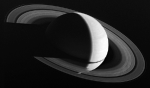 Looking Down on Saturn
17.07.1996
This picture of Saturn could not have been taken from Earth. No Earth based picture could possibly view the night side of Saturn and the corresponding shadow cast across Saturn's rings. Since Earth is much closer to the Sun than Saturn, only the day side of the planet is visible from the Earth.
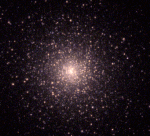 M15: A Great Globular Cluster
26.07.1995
A globular cluster is a system of about one million stars that together orbit a galaxy. One of the brightest globular clusters in our Milky Way galaxy is the pictured M15, the fifteenth object on Messier's list of diffuse objects on our sky.
|
January February March April May June July August September October |
|||||||||||||||||||||||||||||||||||||||||||||||||