
|
You entered: Sun
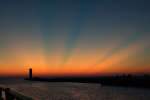 Crepuscular Rays Over Lake Michigan
11.08.2010
What could cause such rays of dark? Dark sky rays were caught in spectacular fashion earlier last month from Pentwater, Michigan, USA, looking west over Lake Michigan. The cause is something surprisingly familiar: shadows. Clouds near the horizon can block sunlight from reflecting off air, making columns outward from the Sun appear unusually dark.
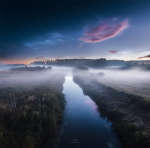 A Northern Summer s Night
7.07.2018
Near a summer's midnight a mist haunts the river bank in this dreamlike skyscape taken on July 3rd from northern Denmark. Reddened light from the Sun a little below the horizon gives an eerie tint to low hanging clouds.
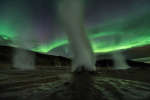 Night on a Spooky Planet
30.10.2022
What spooky planet is this? Planet Earth of course, on a dark and stormy night in 2013 at Hverir, a geothermally active area along the volcanic landscape in northeastern Iceland. Triggered by solar activity, geomagnetic storms produced the auroral display in the starry night sky.
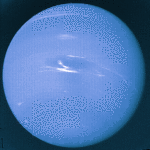 Neptune: Big Blue Giant
17.08.1995
This picture was taken by the Voyager 2 spacecraft in 1986 - the only spacecraft ever to visit Neptune. Neptune will be the farthest planet from the Sun until 1999, when the elliptical orbit of Pluto will cause it to once again resume this status.
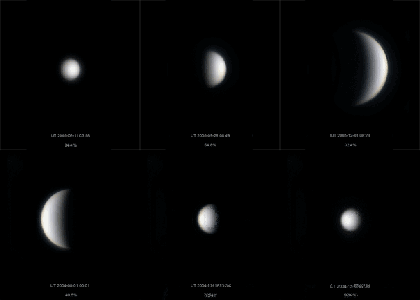 The Phases of Venus
10.01.2006
Venus goes through phases. Just like our Moon, Venus can appear as full as a disk or as a thin as a crescent. Venus, frequently the brightest object in the post-sunset or pre-sunrise sky, appears so small, however, that it usually requires binoculars or a small telescope to clearly see its current phase.
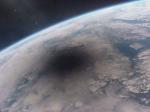 Looking Back on an Eclipsed Earth
30.08.1999
Here is what the Earth looks like during a solar eclipse. The shadow of the Moon can be seen darkening part of Earth. This shadow moves across the Earth at nearly 2000 kilometers per hour.
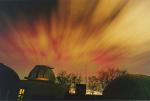 Aurora in Red and Yellow
10.04.2000
The past week brought some spectacular aurora to northern skies. These aurorae were caused by a large interplanetary shock wave that exploded from the Sun on April 4. When the shock wave reached the Earth on April 6, the resulting aurora could be seen in clear skies as far south as North Carolina.
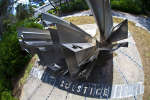 A Sundial that Shows Solstice
26.06.2012
What time is it? If the time and day are right, this sundial will tell you: SOLSTICE. Only then will the Sun be located just right for sunlight to stream through openings and spell out the term for the longest and shortest days of the year. And that happened last week and twice each year.
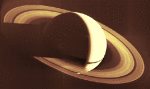 The Night Side of Saturn
5.07.1995
This image of Saturn was made in November 1980 by the Voyager 1 spacecraft as it flew past the ringed gas giant planet. From a spectacular vantage point, looking back toward the inner solar system, the robot spacecraft recorded this view of the night side of Saturn casting a sharp shadow across the bright rings.
 Wild Duck Open Cluster M11
16.01.1996
Many stars like our Sun were formed in open clusters. The above open cluster, M11, contains thousands of stars and is just over three thousand light years distant. The stars in this cluster all formed together about 150 million years ago. The many bright stars in the cluster appear blue.
|
January February March April May June July August September October |
|||||||||||||||||||||||||||||||||||||||||||||||||