
|
You entered: NASA
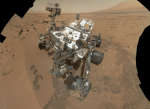 Curiosity Rover at Rocknest on Mars
27.12.2012
What's in this smooth soil on Mars? In late October, NASA's robotic Curiosity rover stopped near a place dubbed Rocknest as it continues to explore Gale Crater on Mars. Rocknest is the group of stones seen near the top left of the above image -- just to the left of Curiosity's mast.
 4000 Exoplanets
10.07.2019
Over 4000 planets are now known to exist outside our Solar System. Known as exoplanets, this milestone was passed last month, as recorded by NASA's Exoplanet Archive. The featured video highlights these exoplanets in sound and light, starting chronologically from the first confirmed detection in 1992.
 The Galaxy, the Jet, and a Famous Black Hole
4.05.2023
Bright elliptical galaxy Messier 87 (M87) is home to the supermassive black hole captured in 2017 by planet Earth's Event Horizon Telescope in the first ever image of a black hole. Giant...
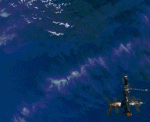 Mir Over New Zealand
26.10.1996
The Russian space station Mir was photographed last month high above New Zealand. Before returning with record-breaking astronaut Shannon Lucid, the space shuttle Atlantis crew took this breathtaking view from the Space Shuttle Atlantis. Atlantis had just undocked from Mir and was preparing to return to Earth.
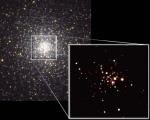 X Ray Stars of 47 Tucanae
24.05.2001
A deep optical image (left) of 47 Tucanae shows an ancient globular star cluster so dense and crowded that individual stars can not be distinguished in its closely packed core. An x-ray image of its central regions (inset right) from the Chandra Observatory reveals a wealth of x-ray stars hidden there.
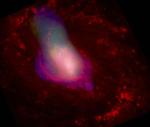 NGC 1068 and the X Ray Flashlight
11.07.2003
At night, tilting a flashlight up under your chin hides the glowing bulb from the direct view of your friends. Light from the bulb still reflects from your face though, and can give you a startling appearance.
 Water Discovered on the Moon
28.09.2009
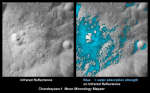
Water has been discovered on the surface of the Moon. No lakes have been found, but rather NASA's Moon Mineralogy Mapper aboard India's new Chandrayaan-1 lunar orbiter radios back that parts of the Moon's surface absorb a very specific color of light identified previously only with water.
 The Galactic Core in Infrared
17.01.2015
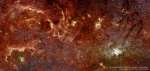
What's happening at the center of our Milky Way Galaxy? To help find out, the orbiting Hubble and Spitzer space telescopes have combined their efforts to survey the region in unprecedented detail in infrared light. Milky Way's center because visible light is more greatly obscured by dust.
 The Galaxy, the Jet, and a Famous Black Hole
9.05.2024
Bright elliptical galaxy Messier 87 (M87) is home to the supermassive black hole captured in 2017 by planet Earth's Event Horizon Telescope in the first ever image of a black hole. Giant...
 A Mystery in Gamma Rays
11.08.2001
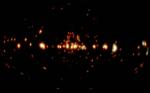
Gamma rays are the most energetic form of light, packing a million or more times the energy of visible light photons. If you could see gamma rays, the familiar skyscape of steady stars would be replaced by some of the most bizarre objects known to modern astrophysics -- and some which are unknown.
|
January February March April May June July August September October |
|||||||||||||||||||||||||||||||||||||||||||||||||