
|
You entered: NASA
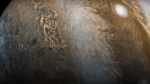 Passing Jupiter
26.02.2018
Here comes Jupiter! NASA's robotic spacecraft Juno is continuing on its 53-day, highly-elongated orbits around our Solar System's largest planet. The featured video is from perijove 11, the eleventh time Juno has passed near Jupiter since it arrived in mid-2016.
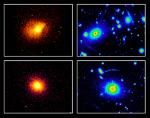 The Matter of Galaxy Clusters
24.10.2001
Situated over 2,000,000,000 (two billion) light-years from Earth, galaxies in cluster Abell 2390 (top) and MS2137.3-2353 (bottom) are seen in the right hand panels above, false-color images from the Hubble Space Telescope. Corresponding panels on the left reveal each cluster's x-ray appearance in images from the Chandra X-ray Observatory.
 SNR 0104: An Unusual Suspect
12.06.2009
SNR 0104 is a supernova remnant with an unusual shape. Found 190,000 light-years away in our neighboring galaxy the Small Magellanic Cloud, SNR 0104 is suspected of being the expanding debris cloud from a Type 1a supernova - the catastrophic thermonuclear explosion of a white dwarf star.
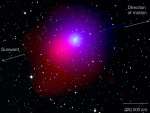 The Swift View of Comet Lulin
21.02.2009
Now growing brighter, Comet Lulin is headed for its closest approach to planet Earth early next week. But the comet's greenish glow, familiar to earthbound skygazers, is replaced by false colors in this premier view from the orbiting Swift satellite.
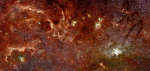 The Galactic Core in Infrared
7.01.2009
What's happening at the center of our Milky Way Galaxy? To help find out, the orbiting Hubble and Spitzer space telescopes have combined their efforts to survey the region in unprecedented detail in infrared light.
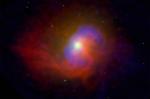 NGC 4696: Energy from a Black Hole
27.04.2006
In many cosmic environments, when material falls toward a black hole energy is produced as some of the matter is blasted back out in jets. In fact, such black hole "engines" appear to be the most efficient in the Universe, at least on a galactic scale.
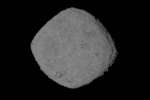 Rotating Asteroid Bennu from OSIRIS REx
13.11.2018
Could this close-by asteroid ever hit the Earth? Eventually yes -- but probably not for a very long time, even though the asteroid is expected to pass inside the orbit of the Moon next century.
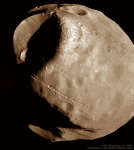 Phobos: Doomed Moon of Mars
25.11.2018
This moon is doomed. Mars, the red planet named for the Roman god of war, has two tiny moons, Phobos and Deimos, whose names are derived from the Greek for Fear and Panic. The origin of the Martian moons is unknown, though, with a leading hypothesis holding that they are captured asteroids.
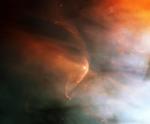 LL Orionis: When Cosmic Winds Collide
15.11.2003
This arcing, graceful structure is actually a bow shock about half a light-year across, created as the wind from young star LL Orionis collides with the Orion Nebula flow. Adrift in Orion's stellar...
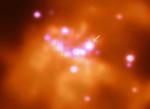 M82 s Middle Mass Black Hole
14.09.2000
Black holes are probably the most bizarre creatures in the modern astronomical zoo. And after years of pondering black holes as either stellar mass objects seen in binary star systems or enormous supermassive black holes at the centers of galaxies, astronomers now have strong evidence
|
January February March April May June July August September October |
|||||||||||||||||||||||||||||||||||||||||||||||||