
|
You entered: NASA
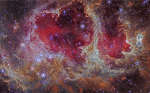 W5: Pillars of Star Formation
15.12.2014
How do stars form? Images of the star forming region W5 like those in the infrared by NASA's Wide Field Infrared Survey Explorer (WISE) satellite provide clear clues with indications that massive stars near the center of empty cavities are older than stars near the edges.
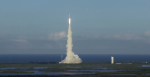 An Atlas V Rocket Launches OSIRIS REx
16.10.2016
Have you ever seen a rocket launched into the Solar System? Last month a large Atlas V rocket blasted off from Launch Complex 41 in Florida carrying the ORISIX-REx spacecraft. This robotic spacecraft will attempt to land on Asteroid Bennu and return some of its soil to Earth.
 APOD: 2025 August 9 Б Interstellar Interloper 3I/ATLAS from Hubble
8.08.2025
Discovered on July 1 with the NASA-funded ATLAS (Asteroid Terrestrial-impact Last Alert System) survey telescope in Rio Hurtado, Chile, 3I/ATLAS is so designated as the third known interstellar object to pass through our Solar System. It follows 1I/йOumuamua in 2017 and the comet 2I/Borisov in 2019.
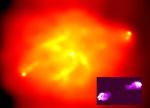 X Ray Cygnus A
5.10.2002
Amazingly detailed, this false-color x-ray image is centered on the galaxy Cygnus A. Recorded by the orbiting Chandra Observatory, Cygnus A is seen here as a spectacular high energy x-ray source. But it is actually more famous at the low energy end of the electromagnetic spectrum as one of the brightest celestial radio sources.
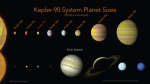 The Kepler 90 Planetary System
27.04.2020
Do other stars have planetary systems like our own? Yes -- one such system is Kepler-90. Cataloged by the Kepler satellite that operated from Earth orbit between 2009 and 2018, eight planets were discovered, giving Kepler-90 the same number of known planets as our Solar System.
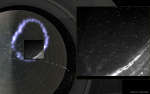 Aurorae and Lightning on Jupiter
23.03.2021
Why does so much of Jupiter's lightning occur near its poles? Similar to Earth, Jupiter experiences both aurorae and lightning. Different from Earth, though, Jupiter's lightning usually occurs near its poles -- while much of Earth's lightning occurs near its equator.
 Large Sunspot Group AR 9393
11.04.2001
The largest sunspot group of the past ten years crossed the surface of the Sun late last month and early this month. The group was designated Active Region 9393 as it was the 9393rd region identified since counting officially began in 1973.
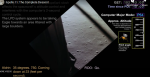 Apollo 11: Descent to the Moon
16.07.2019
It had never been done before. But with the words "You're Go for landing", 50 years ago this Saturday, Apollo 11 astronauts Aldrin and Armstrong were cleared to make the first try.
 Zeta Oph: Runaway Star
3.01.2024
Like a ship plowing through cosmic seas, runaway star Zeta Ophiuchi produces the arcing interstellar bow wave or bow shock seen in this stunning infrared portrait. In the false-color view, bluish Zeta...
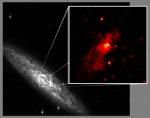 NGC 253: X Ray Zoom
7.06.2001
Astronomers now report that Chandra X-ray Observatory observations of galaxies known to be frantically forming stars show that these galaxies also contain luminous x-ray sources -- thought to be intermediate mass black holes and immense clouds of superheated gas. Take the lovely island universe NGC 253 for example.
|
January February March April May June July August September October |
|||||||||||||||||||||||||||||||||||||||||||||||||