
|
You entered: NASA
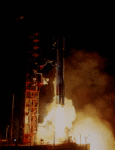 Surveyor Night Launch
3.11.1996
In early November of 1967, a dramatic night launch of an Atlas Centaur rocket from Cape Canaveral lofted the successful Surveyor 6 spacecraft toward the Moon. The Surveyor series of robotic probes carried out the first US lunar soft landings in preparation for the Apollo program.
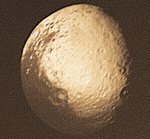 Iapetus: Saturn's Disappearing Moon
15.10.1995
Iapetus has an unusual surface, one half of which is very dark, the other half very light. This caused it's discoverer Cassini to remark that Iapetus could only be seen when on one side of Saturn but not the other. The reason for the difference between hemispheres is presently unknown.
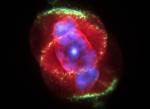 X-rays From The Cat's Eye
11.01.2001
Haunting patterns within planetary nebula NGC 6543 readily suggest its popular moniker -- the Cat's Eye nebula. In 1995, a stunning false-color optical image from the Hubble Space Telescope detailed the swirls of this glowing nebula, known to be the gaseous shroud expelled from a dying sun-like star about 3,000 light-years from Earth.
 APOD: 2025 May 6 Б The Doubly Warped World of Binary Black Holes
6.05.2025
If one black hole looks strange, what about two? Light rays from accretion disks around a pair of orbiting supermassive black holes make their way through the warped space-time produced by extreme gravity in this detailed computer visualization.
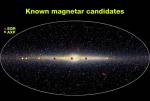 Magnetars In The Sky
1.09.2001
Indicated on this infrared image of the galactic center region are positions of candidate magnetars -- believed to be the strongest magnets in the galaxy. Classified by observers as Soft Gamma Repeaters (SGRs) and Anomalous X-ray Pulsars (AXPs), these cosmic powerhouses are likely city-sized, spinning, highly-magnetized neutron stars. How strong is a magnetar's magnetic field?
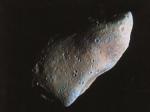 Asteroid Gaspra's Best Face
12.07.1998
Asteroid 951 Gaspra is a huge rock tumbling in space. Gaspra became one of the best-studied asteroids in 1991 when the spacecraft Galileo flew by. In the above photograph, subtle color variations have been exaggerated to highlight changes in reflectivity, surface structure and composition.
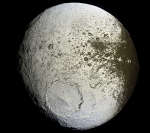 Saturns Iapetus: Painted Moon
9.08.2009
What has happened to Saturn's moon Iapetus? Vast sections of this strange world are dark as coal, while others are as bright as ice. The composition of the dark material is unknown, but infrared spectra indicate that it possibly contains some dark form of carbon.
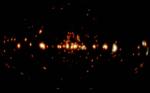 A Mystery in Gamma Rays
3.04.2004
Gamma rays are the most energetic form of light, packing a million or more times the energy of visible light photons. If you could see gamma rays, the familiar skyscape of steady stars would be replaced by some of the most bizarre objects known to modern astrophysics -- and some which are unknown.
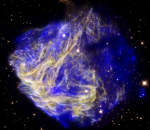 Fast Gas Bullet from Cosmic Blast N49
30.06.2010
What is that strange blue blob on the far right? No one is sure, but it might be a speeding remnant of a powerful supernova that was unexpectedly lopsided. Scattered debris from supernova explosion N49 lights up the sky in this gorgeous composited image based on data from the Chandra and Hubble Space Telescopes.
 Young Star Cluster NGC 346
2.05.2025
The most massive young star cluster in the Small Magellanic Cloud is NGC 346, embedded in our small satellite galaxy's largest star forming region some 210,000 light-years distant. Of course the massive stars of NGC 346 are short lived, but very energetic.
|
January February March April May June July August September October |
|||||||||||||||||||||||||||||||||||||||||||||||||