
|
You entered: NASA
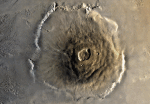 The Mountains of Mars
19.07.1995
Volcanic activity on Mars has produced towering mountains. The largest one, Olympus Mons, is pictured here in this Viking Orbiter image. Olympus Mons is a shield volcano nearly 15 miles high and over 300 miles wide at its base.
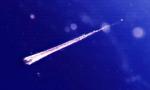 Catching Falling Stardust
21.11.1998
This carrot shaped track is actually little more than 5 hundredths of an inch long. It is the trail of a meteroid through the high-tech substance aerogel exposed to space by the shuttle launched EURECA (European Recoverable Carrier) spacecraft.
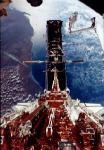 Orbiting Repairmen
28.01.1996
In December of 1993 astronauts Story Musgrave and Jeffrey Hoffman performed the orbiting repairmans' ballet 400 miles above the Earth. They are seen in this photo perched at the end of the Space Shuttle Endeavour's robotic arm making final repairs to the four story tall Hubble Space Telescope.
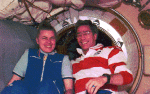 Welcome Home Shannon Lucid
27.09.1996
Today is Shannon Lucid's first day on Planet Earth in six months. Her stay aboard Russia's Mir Space Station was of record length - the longest stay of any American in space ever.
 Arachnoids on Venus
20.01.1998
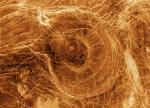
Arachnoids are large structures of unknown origin that have been found only on the surface of Venus. Arachnoids get their name from their resemblance to spider-webs. They appear as concentric ovals surrounded by a complex network of fractures, and can span 200 kilometers.
 Our Solar System from Voyager
17.05.1998
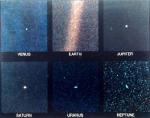
After taking spectacular pictures of our Solar System's outer planets, Voyager 1 looked back at six planets to take our Solar System's first family portrait. Here Venus, Earth, Jupiter, Saturn, Uranus, and Neptune, were all visible across the sky.
 Water World
16.03.1997
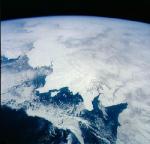
Water (Dihydrogen Oxide, H2O) is a truly remarkable chemical compound, fundamental to life on Earth. Earth is the only planet in the Solar System where the surface temperature and pressure allow the three forms of water, solid (ice), liquid (ocean), and gas (water vapor condensing in clouds) to exist simultaneously on its surface.
 The Wind on Mars
12.01.1999
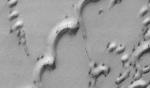
Wind erosion has been discovered on Mars. Pictures of regions surrounding the north polar cap show sand dunes covered in frost. In places, however, this frost has been eroded to uncover the dark sand underneath.
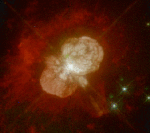 Eta Carinae Before Explosion
12.07.1995
The star Eta Carinae, at the center of the photo, will likely destroy itself in a spectacular explosion in a few million years - or sooner! Currently it is one of the brightest, most massive, and least stable stars known. Much of the gas in this Hubble Space Telescope photograph was blown off the star itself.
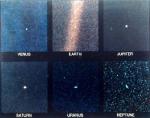 Our Solar System from Voyager
14.12.1996
After taking spectacular pictures of our Solar System's outer planets, Voyager 1 looked back at six planets to take our Solar System's first family portrait. Here Venus, Earth, Jupiter, Saturn, Uranus, and Neptune, were all visible across the sky.
|
January February March April May June July August September October |
|||||||||||||||||||||||||||||||||||||||||||||||||