
|
You entered: NASA
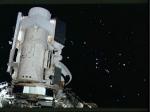 Astro 1 In Orbit
20.02.1999
In December of 1990, the Space Shuttle Columbia carried an array of astronomical telescopes high above the Earth's obscuring atmosphere to observe the Universe at ultraviolet and x-ray wavelengths. The telescopes, known...
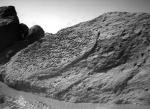 Half Dome Rock on Mars
30.09.1997
Who ordered the Martian pizza? As Mars Pathfinder and its mobile robot Sojourner continue to explore Mars, new and interesting rocks are being discovered, even though the primary mission has been successfully completed. The rock pictured above has been dubbed "Half Dome" and was visited by Sojourner in late August.
 Surveyor Slides
20.10.1996
"Safe!" -- In September 1967 (during regular season play), while making a successful soft landing on the Moon's Mare Tranquillitatis, the Surveyor 5 lander actually slid several feet. Equipped with television cameras and some...
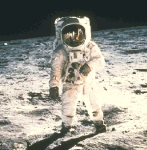 Standing on the Moon
22.09.1995
Pictured, the second person to walk on the Moon: Edwin "Buzz" Aldrin. During this Apollo 11 mission, Neil Armstrong and Buzz Aldrin landed on the Moon while Michael Collins circled in the Command Module above.
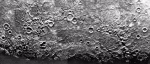 Mercury's Caloris Basin
20.01.1996
Mercury, the closest planet to the Sun, has a surface with so many craters it resembles the Earth's Moon. The largest surface feature on Mercury is the Caloris Basin, which resulted from a collision with an asteroid.
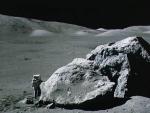 Apollo 17: Boulder on the Moon
5.09.1997
Twenty five years ago humans roamed the Moon. Pictured here during the last moon landing, scientist-astronaut Harrison Schmitt was photographed standing next to a huge, split boulder. Apollo 17 was one of six missions that landed humans on the moon and returned them safely.
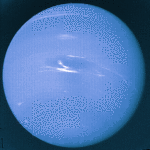 Neptune: Big Blue Giant
21.02.1998
This picture was taken by the Voyager 2 spacecraft in 1989 - the only spacecraft ever to visit Neptune. Neptune will be the farthest planet from the Sun until 1999, when the elliptical orbit of Pluto will cause it to once again resume this status.
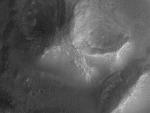 Mars: Cydonia Close Up
16.04.1998
The Mars Global Surveyor spacecraft has returned another close-up of the Cydonia region on Mars. Orbiting over clear Martian skies at a range of about 200 miles, the Mars Orbiter Camera looked down...
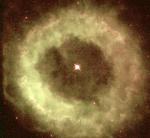 NGC 6369: A Donut Shaped Nebula
18.05.1998
Why isn't the star in the center of the nebula? NGC 6369 appears to be a fairly ordinary planetary nebula. It can be seen with a good telescope in the constellation of Ophiuchus. The gas expelled by the central star is bunched in the shape of a donut or cylinder.
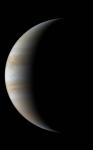 Farewell Jupiter
8.08.2001
Next stop: Saturn. The Cassini spacecraft, launched from Earth four years ago, has now swung past Jupiter and should arrive at Saturn in the year 2004. Pictured to the left is a parting shot from Cassini in January that would not have been possible from Earth: Jupiter showing a crescent phase.
|
January February March April May June July August September October |
|||||||||||||||||||||||||||||||||||||||||||||||||