
|
You entered: NASA
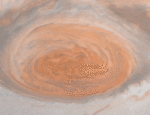 Galileo Zooms in on Jupiter's Red Spot
27.08.1996
What does the largest storm system ever recorded look like close-up? This storm system is Jupiter's Great Red Spot and it was captured recently in detail by the robot spacecraft Galileo now in orbit around Jupiter.
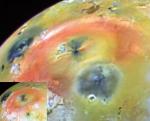 Dark Volcano Active on Io
10.11.1997
The surface of Io is changing even as we watch. The inset frame of Jupiter's most active moon was taken by the robot spacecraft Galileo in April. Just last month the larger image was taken. The new large black spot reveals that a volcano named Pillan Patera has been erupting during the interim.
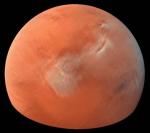 Clouds Over Tharsis on Mars
17.03.1998
When and where do clouds form on Mars? The Mars Global Surveyor spacecraft currently orbiting Mars is finding out. Photographs released last week showed clouds forming above Tharsis, a huge bulge on Mars about 4000 kilometers across and 7 kilometers high containing several large volcanoes.
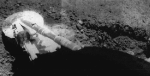 Surveyor Slides
14.11.1998
"Safe!" In September 1967 (during regular season play), the Surveyor 5 lander actually slid several feet while making a successful soft landing on the Moon's Mare Tranquillitatis. Equipped with television cameras and soil...
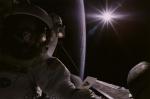 Dark Sky, Bright Sun
14.02.1999
In low Earth orbit there is not enough atmosphere to diffuse and scatter sunlight, so shadows are black and the sky is dark - even when the Sun shines. The harsh lighting produced this dramatic...
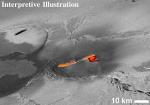 Lava Fountain on Jupiter's Io
20.12.1999
A lava fountain shooting over a kilometer high has been discovered on Jupiter's moon Io. The robot Galileo spacecraft orbiting Jupiter photographed the volcanic eruption during its close flyby of the moon late last month. The fountain is visible in the above mosaic of images from the flyby.
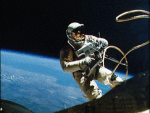 Walking in Space
1.08.1999
Pictured above is the first american astronaut to walk in space: Edward White. White is seen floating outside the Gemini 4 capsule in 1965. The term spacewalk is deceiving since astronauts do not actually walk - they float - usually without their feet touching anything solid. White was connected to the spaceship only by a thick tether.
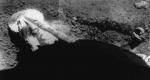 Surveyor Slides
13.05.2000
"Safe!" In September 1967 (during regular season play), the Surveyor 5 lander actually slid several feet while making a successful soft landing on the Moon's Mare Tranquillitatis. Equipped with television cameras and soil...
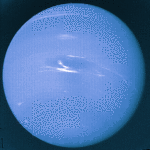 Neptune: Big Blue Giant
17.08.1995
This picture was taken by the Voyager 2 spacecraft in 1986 - the only spacecraft ever to visit Neptune. Neptune will be the farthest planet from the Sun until 1999, when the elliptical orbit of Pluto will cause it to once again resume this status.
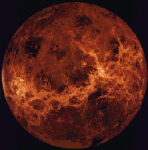 Venus UnVeiled
22.08.1995
The surface of Venus is perpetually covered by a veil of thick clouds and remains hidden from even the powerful telescopic eyes of earth-based astronomers. However, using an imaging radar technique, the Magellan spacecraft...
|
January February March April May June July August September October |
|||||||||||||||||||||||||||||||||||||||||||||||||