
|
You entered: NASA
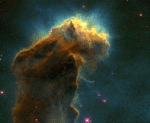 Eagle EGGs in M16
7.11.1995
Star forming regions known as "EGGs" are uncovered at the end of this giant pillar of gas and dust in the Eagle Nebula (M16). EGGs, short for evaporating gaseous globules, are dense regions of mostly molecular hydrogen gas that fragment and gravitationally collapse to form stars.
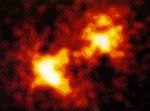 An X-ray Hot Supernova in M81
3.12.1995
In 1993, a star in the galaxy M81 exploded. Above is a picture of the hot material ejected by this supernova explosion. The picture was taken in X-rays with the Advanced Satellite for Cosmology and Astrophysics (ASCA).
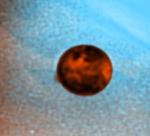 Eruption on Io
23.06.1997
There it goes again. Gas and rock were catapulted hundreds of kilometers into space as Jupiter's most volatile moon, Io, showed yet another impressive volcanic display in this just-released photograph by the Hubble Space Telescope.
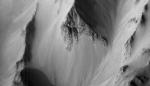 Mars: A Sheer Close Up
13.11.1997
As the Mars Global Surveyor spacecraft maneuvers toward its final mapping orbit, its cameras have been producing some sharp views of Mars. At a resolution of better than 30 feet per pixel, this image...
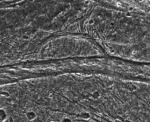 Mysterious Features on Ganymede
9.12.1997
Where is the rest of the circle? Jupiter's largest moon Ganymede has some truly unusual terrain, including the pictured half circle above cut by nearly parallel curves. Full circles can be easily explained by impact craters, but partial circles imply that some resurfacing has occurred since the original impact.
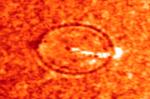 Solar Flares Cause Sun Quakes
1.06.1998
An 11th magnitude quake has been recorded on the Sun, immediately following a moderate solar flare. The quake was the first ever recorded on the Sun, but only because astronomers have only recently figured out when and how to find them using the orbiting SOHO spacecraft.
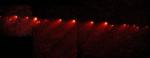 A String Of Pearls
14.08.1999
Comet Shoemaker-Levy 9, named after its co-discoverers, was often referred to as the "string of pearls" comet. It is famous for its suggestive appearance as well as its collision with the planet Jupiter!
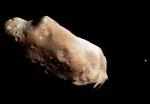 Ida and Dactyl: Asteroid and Moon
7.08.1999
This asteroid has a moon! The robot spacecraft Galileo currently exploring the Jovian system, encountered and photographed two asteroids during its long journey to Jupiter. The second asteroid it photographed, Ida, was discovered to have a moon which appears as a small dot to the right of Ida in this picture.
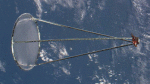 The Shuttle Launches an Inflatable Antenna
25.05.1996
High above the Earth the Space Shuttle Endeavor launches a new type of instrument - an inflatable antenna. The officially designated Inflatable Antenna Experiment was released Monday, May 20th, as part of a Spartan satellite - which contains many scientific experiments. The antenna is roughly the size of a tennis court and is even visible from Earth.
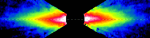 The Dusty Disk of Beta Pic
19.01.1996
This dusty disk, viewed edge on surrounding Beta Pictoris, a star only 50 lightyears distant, may signal the presence of an infant solar system. Beta Pictoris is a young Sun-like star just completing its formative stages.
|
January February March April May June July August September October |
|||||||||||||||||||||||||||||||||||||||||||||||||