
|
You entered: NASA
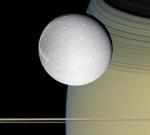 Ringside
21.10.2005
Orbiting in the plane of Saturn's rings, Dione and the other icy saturnian moons have a perpetual ringside view of the gorgeous gas giant planet. Of course, while passing through the ring plane the Cassini spacecraft also shares their stunning perspective.
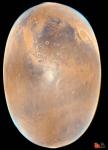 A Mars Glint
8.06.1998
If aligned just right, even a planet can produce a glint. The above combined pictures of Mars make the red planet appear unusually elongated - Mars is really almost spherical. However, these pictures were taken when the Sun was nearly directly behind the Mars Global Surveyor (MGS) spacecraft.
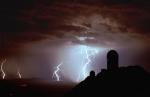 Lightning on Earth
17.07.2000
Nobody knows what causes lightning. It is known that charges slowly separate in some clouds causing rapid electrical discharges (lightning), but how electrical charges get separated in clouds remains a topic of much research.
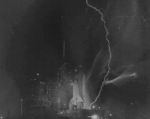 Lightning and the Space Shuttle
10.11.1995
There are many things about lightning that are not understood. Lightning has been seen in the atmospheres of Venus, Earth, Jupiter, and Saturn. A leading theory is that collisions of particles in clouds cause large areas of positive and negative charge.
 Lasers in Eta Carinae
11.01.1996
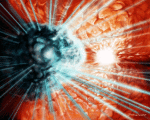
Have you heard about the great LASER light show in the sky? Well, nobody had until it was announced just yesterday by a team led by K. Davidson (U. Minnesota) and S. Johansson (U. Lund).
 Sputnik: Traveling Companion
27.04.1997
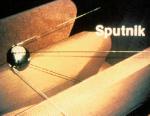
Sputnik means "traveling companion". Despite the innocuous sounding name, the launch of the Earth's first "artificial moon", Sputnik 1, by the Soviets on October 4, 1957 shocked the free world, setting in motion events which resulted in the creation of NASA and the race to the Moon.
 Epimetheus: A Small Moon of Saturn
24.08.2005
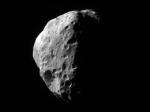
How did Epimetheus form? No one is yet sure. To help answer that question, this small moon has recently been imaged again in great detail by the robot spacecraft Cassini now orbiting Saturn. Epimetheus sometimes orbits Saturn in front of Janus, another small satellite, but sometimes behind.
 Welcome to Planet Earth
26.10.1997
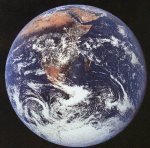
Welcome to Planet Earth, the third planet from a star named the Sun. The Earth is shaped like a sphere and composed mostly of rock. Over 70 percent of the Earth's surface is water. The planet has a relatively thin atmosphere composed mostly of nitrogen and oxygen.
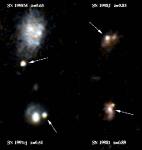 The Year of Distant Supernovae
31.12.1998
Distant supernovae were among topics at the forefront of astronomy during 1998. Two independent groups raced to deploy large telescopes to scan the sky, discovering and analyzing far-off supernovae with the promise of calibrating the geometry of our universe.
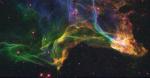 The Cygnus Loop
23.06.2001
The shockwave from a 20,000 year-old supernova in the constellation of Cygnus supernova explosion is still expanding into interstellar space. The collision of this fast moving wall of gas with a stationary cloud...
|
January February March April May June July August September October |
|||||||||||||||||||||||||||||||||||||||||||||||||