
|
You entered: NASA
 A Martian Sunset
1.08.1997
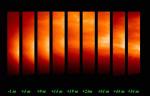
You've had a hard day rolling past Martian rocks, so now just relax your APXS and enjoy the Martian sunset. The above pictures taken by Mars Pathfinder highlight how clouds vary during the end of a Martian day.
 Comet Halley and the Milky Way
3.10.1997
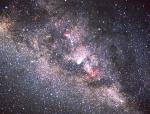
Comet Halley was photographed superposed in front of the disk of our Milky Way Galaxy in 1986 by the Kuiper Airborne Observatory. Comet Halley is the bright white streak near this photograph's center. Comet Halley is the most famous comet in history, and returns to the inner Solar System every 76 years.
 Solar Magnetic Bananas
29.06.1998
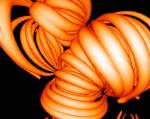
Is that our Sun? The unusual banana-shaped loops shown above are actually part of a computer-generated snap-shot of our Sun's magnetic field. This animated frame was constructed using data from the ground-based U.S. Solar Vector Magnetograph and the space-based Japanese X-Ray Telescope Yohkoh.
 In the Center of the Trapezium
10.07.2005
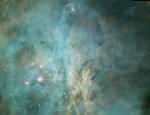
Start with the constellation of Orion. Near Orion's belt is a fuzzy area known as the Great Nebula of Orion or M42. In this nebula is a bright star cluster known as the Trapezium, shown above. New stellar systems are forming there in gigantic globs of gas and dust known as Proplyds.
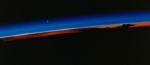 Venus on the Horizon
19.06.1999
Venus can appear as a brilliant evening star. Besides the sun and moon, Venus is the brightest object visible in Earth's sky. Because it is closer to the sun than Earth, Venus never...
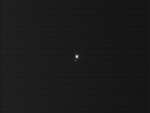 Earth and Moon from Saturn
22.07.2013
You are here. Everyone you've ever known is here. Every human who has ever lived -- is here. Pictured above is the Earth-Moon system as captured by the Cassini mission orbiting Saturn in the outer Solar System.
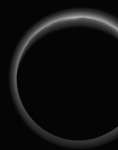 Pluto at Night
9.06.2016
The night side of Pluto spans this shadowy scene. The spacebased view with the Sun behind the distant world was captured by New Horizons last July. The spacecraft was at a range of over 21,000 kilometers, about 19 minutes after its closest approach.
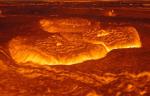 Venus Once Molten Surface
26.03.2000
If you could look at Venus with radar eyes - this is what you might see. This computer reconstruction of the surface of Venus was created from data from the Magellan spacecraft. Magellan orbited Venus and used radar to map our neighboring planet's surface between 1990 and 1994.
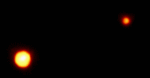 Pluto: The Frozen Planet
18.08.1995
The Hubble Space Telescope imaged Pluto and its moon Charon in 1994. Pluto is usually the most distant planet from the Sun but because of its elliptic orbit Pluto crossed inside of Neptune's orbit in 1979 and will cross back out again in 1999.
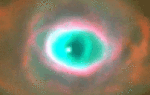 The Eye of an Hourglass Nebula
9.02.1996
What's happening in the eye-like center of this planetary nebula? The geometry revealed in this Hubble Space Telescope view of the central part of an "etched hourglass nebula" known as MyCn 18 presents a puzzle. First, the axis of this central region does not line up well with the outer hourglass structure.
|
January February March April May June July August September October |
|||||||||||||||||||||||||||||||||||||||||||||||||