
|
You entered: NASA
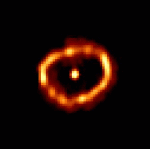 Nova Cygni 1992
27.12.1995
In 1992 a tremendous explosion occurred in the constellation of Cygnus. Dubbed Nova Cygni 1992, this event most probably occurred in an accretion disk binary system. Astronomers hypothesize that this system's white dwarf had so much gas dumped onto it's surface that conditions became ripe for nuclear fusion.
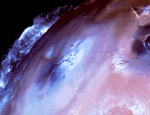 Erupting Volcanoes on Io
5.08.1996
Jupiter's moon Io has active volcanoes. The Voyager spacecraft caught several erupting when they passed the energetic moon in 1979. In the above picture, several of Io's volcanoes are visible and one is seen actually erupting.
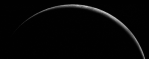 A Crescent Earth At Midnight
6.10.1996
The Earth's northern hemisphere appears outlined as a sunlit crescent in this dramatic view from the GOES 8 satellite. The image was made near midnight for the Geostationary Operational Environmental Satellite on June 22 this year, two days after the Summer Solstice.
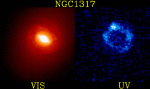 Starburst Ring in Galaxy NGC 1317
11.12.1996
Where do stars form? A typical place is an area of dense nebular gas common to arms in spiral galaxies. Sometimes, however, a burst of star formation can occur with unusual geometry. Nearby galaxy NGC 1317 shows such an unusual ring of star formation surrounding its barred nucleus.
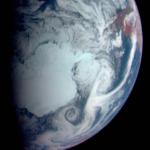 A Passing Spaceship Views Earth
4.02.1998
This is how Earth appeared to the passing spacecraft NEAR. The Near Earth Asteroid Rendezvous (NEAR) spacecraft was launched from Florida, USA, planet Earth in 1996. After a quick flyby of asteroid Mathilde in June last year, NEAR passed the Earth two weeks ago on its way to asteroid 433 Eros.
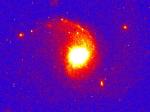 Quasar in an Elliptical Galaxy
9.04.1998
Where do quasars live? Quasars are the brightest objects in the universe, so bright they can be seen from across the universe. Observations continue to show that most quasars are surrounded by a relatively faint nebulous patch. Astronomers are trying to identify the nature of these patches.
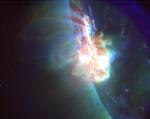 An Active Region of the Sun
16.06.1998
The Sun is a busy place. This false-color image depicts an active region near an edge of the Sun. Hot plasma is seen exploding off the Sun's photosphere and traveling along loops defined by the Sun's magnetic field.
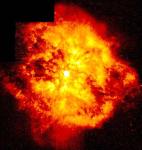 WR124: Stellar Fireball
9.11.1998
Some stars explode in slow motion. Rare, massive Wolf-Rayet stars are so tumultuous and hot they are disintegrating right before our telescopes. Glowing gas globs each over 30 times more massive than the Earth are being expelled by a violent stellar wind.
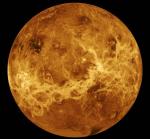 Venus Unveiled
3.09.2005
The surface of Venus is perpetually covered by a veil of thick clouds and remains hidden from even the powerful telescopic eyes of earth-bound astronomers. But in the early 1990s, using imaging radar...
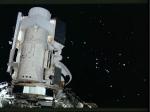 Astro 1 In Orbit
3.12.2005
Fifteen years ago, in December of 1990, the Space Shuttle Orbiter Columbia carried an array of astronomical telescopes high above the Earth's obscuring atmosphere to explore the Universe at ultraviolet and x-ray wavelengths.
|
January February March April May June July August September October |
|||||||||||||||||||||||||||||||||||||||||||||||||