
|
You entered: NASA
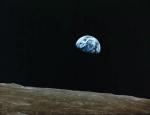 The Millennium that Defined Earth
31.12.2000
When the second millennium began, people generally knew that the Earth was round, but few saw much of it beyond their local village. As the millennium progressed, humans mapped the continents, circumnavigated the globe, and determined the composition of the Earth.
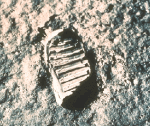 One Small Step
21.09.1995
On July 20th, 1969, a human first set foot on the Moon. Pictured above is the first lunar footprint. The footprint and distinction of the first person to walk on the Moon belong to Neil Armstrong.
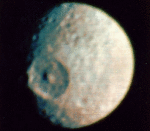 Mimas: Small Moon with A Big Crater
24.09.1995
Mimas is one of the smaller moons of Saturn but shows one of the largest impact craters! In fact, if the impact had been much greater, it would have disrupted the entire satellite. The large crater has been named Herschel after the 1789 discoverer of Mimas, Sir William Herschel.
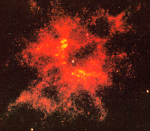 NGC 2440 Nucleus: The Hottest Star?
30.11.1995
In the center of the above photograph lies a star with one of the hottest surface temperatures yet confirmed. This bright white dwarf star's surface has been measured at greater than 200,000 degrees Celsius - more than 30 times hotter than that of our own Sun.
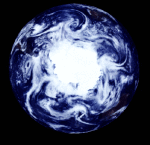 Summer at the South Pole
22.12.1995
December 22 marks the Winter Solstice - the beginning of winter in the Earth's northern hemisphere, and the first day of summer in the south! This view of Earth's southern hemisphere near the beginning of its summer was created using images from the Galileo spacecraft taken during the December 1990 flyby.
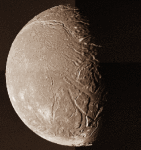 Uranus' Moon Ariel: Valley World
3.03.1996
What formed Ariel's valleys? This question presented itself when Voyager 2 passed this satellite of Uranus in January 1986. Speculation includes that heating caused by the ancient tides of Uranus caused moonquakes and massive shifting of the moon's surface.
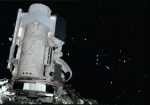 Astro 1 In Orbit
4.05.1996
In December of 1990, the Space Shuttle Columbia carried an array of astronomical telescopes high above the Earth's obscuring atmosphere to observe the Universe at ultraviolet and x-ray wavelengths. The telescopes, known...
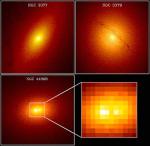 Black Holes and Galactic Centers
14.01.1997
Do all galaxies have black holes at their centers? Although not even a single galaxy has yet been proven to have a central black hole, the list of candidates has increased yet again. Recent...
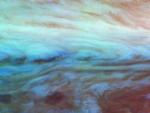 Jupiter: At The Belt-Zone Boundary
10.03.1997
Jupiter's thick atmosphere is striped by wind-driven cloud bands that remain fixed in latitude - dark colored bands are known as belts while light colored bands are zones. At Jupiter's belt-zone boundaries the shearing wind velocities can reach nearly 300 miles per hour.
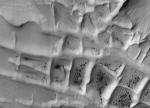 Mars: Ridges Near the South Pole
20.03.1998
No, it's not breakfast ... but looking down from an orbiting spacecraft, the odd intersecting ridges covering this area of Mars do present a waffle-like appearance. The cause of the ridge pattern is unknown but it suggests that more complex layered deposits lie below.
|
January February March April May June July August September October |
|||||||||||||||||||||||||||||||||||||||||||||||||