
|
You entered: NASA
 HH-47 Star Jet
12.10.1995
The star masked by a dust cloud at the left of the above photo is expelling an energetic beam of charged particles into interstellar space. This jet, moving from left to right, has burrowed through much interstellar material, and now expands out into the interstellar space.
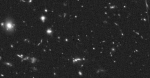 The Dawn of the Clusters
15.01.1996
What did the universe look like near the beginning? This exciting photo by the Hubble Space Telescope is one of the deepest ever taken, and shows galaxies as far away as ever before photographed. The universe back then - when only one third of its present age - was a strange and violent place.
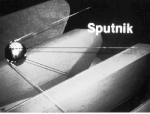 Sputnik: The Traveling Companion
11.02.1996
Sputnik means "traveling companion". In stark contrast to this innocent sounding name, the launch of the Earth's first "artificial moon", Sputnik 1, by the Soviets on October 4, 1957 shocked the free world, setting in motion events which resulted in the creation of NASA and the race to the Moon.
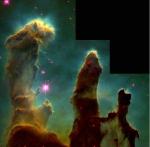 Stars from Eagle's EGGs
12.04.1998
Newborn stars are forming in the Eagle Nebula. This image, taken with the Hubble Space Telescope in 1995, shows evaporating gaseous globules (EGGs) emerging from pillars of molecular hydrogen gas and dust. The giant pillars are light years in length and are so dense that interior gas contracts gravitationally to form stars.
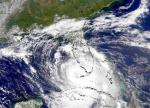 A Hurricane in the Gulf
28.09.1998
Last Friday, Hurricane Georges was photographed from space entering the Gulf of Mexico. This immense storm system, larger than most states, is expected to make landfall today. Starting as a slight pressure difference, hurricanes grow into large spiraling storm systems of low pressure, complete with high winds and driving rain.
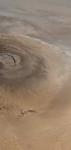 Olympus Mons From Orbit
19.10.1998
Olympus Mons on Mars is the largest volcano in the Solar System. Although three times higher than Earth's Mount Everest, Olympus Mons would not be difficult to climb because of the volcano's great breadth.
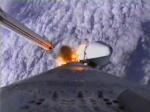 Mars Climate Orbiter Launches
24.12.1998
Looking down from atop a Delta II rocket blasting skyward, solid fuel boosters fall away (left) and the Earth's limb slides into view. These pictures from the launch of the Mars Climate Orbiter were taken as it climbed away from Cape Canaveral Air Station Space Launch Complex 17 on December 11.
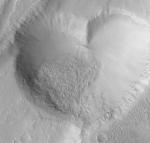 From Mars with Love
28.06.1999
Are Martians trying to tell us something? An indentation has been recently photographed on Mars that resembles a heart, a common human symbol for love. Because intelligent Martians have never been known to exist...
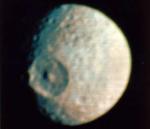 Mimas: Small Moon with a Big Crater
25.04.1999
Mimas is one of the smaller moons of Saturn but shows one of the largest impact craters. In fact, if the impact had been much greater, it would have disrupted the entire satellite. The large crater has been named Herschel after the 1789 discoverer of Mimas, Sir William Herschel.
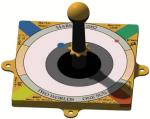 A Sundial for Mars
28.04.1999
When Mars Surveyor arrives at Mars in 2002, it will carry a sundial. Even though batteries and a solar array will power the Mars Surveyor Lander, the sundial has been included to allow a prominent public display of time.
|
January February March April May June July August September October |
|||||||||||||||||||||||||||||||||||||||||||||||||