
|
You entered: NASA
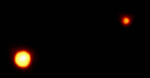 Pluto: The Frozen Planet
28.12.1997
The Hubble Space Telescope imaged Pluto and its moon Charon in 1994. Pluto is usually the most distant planet from the Sun but because of its elliptic orbit Pluto crossed inside of Neptune's orbit in 1979 and will cross back out again in 1999.
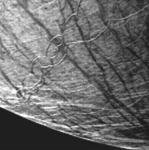 Ice Cusps on Europa
9.06.1998
Europa's icy crust has many unusual features. Pictured above is part of Europa's southern hemisphere photographed by the Galileo spacecraft currently orbiting Jupiter. Europa is one of the largest moons of Jupiter, and is thought to have oceans of water underneath its ice-covered surface.
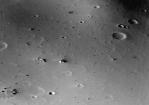 18 Miles From Deimos
19.09.1998
Diminutive Deimos is the smallest of the two tiny Moons of Mars. Potato-shaped and barely 6 miles wide this asteroid-like body was visited by the Viking 2 orbiter in 1977. This image was made when the spacecraft approached to within 18 miles of Deimos' surface.
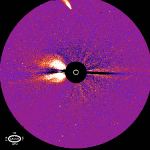 Comet Hyakutake and a Solar Flare
17.05.1996
A rare coincidence was recently captured by the orbiting SOHO spacecraft. During the closest approach to the Sun of Comet Hyakutake on May 1, SOHO photographed the comet. By accident -- during the time this photograph was being taken -- a solar flare was being ejected from the Sun.
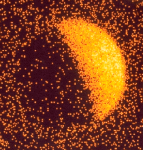 X-Raying the Moon
31.08.1995
Above is a picture of the Moon taken in X-rays by the Roentgen Observatory Satellite ROSAT in 1990. This famous picture shows three distinct regions: a bright X-ray sky, a bright part of the Moon, and a relatively dark part of the Moon.
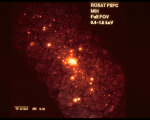 The X-ray Sources of M31
31.12.1995
Just like our own Milky Way Galaxy, the nearest major galaxy M31 has many star systems spewing high energy radiation. High energy X-radiation is visible to certain satellites in Earth orbit such as ROSAT - which took the above picture.
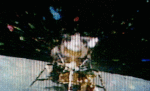 Blasting Off From the Moon
9.06.1996
How did the astronauts get back from the Moon? The Lunar Module that landed two astronauts on the Moon actually came apart. The top part containing the astronauts carried additional rocket fuel which allowed it to blast away, leaving the bottom part on the Moon forever.
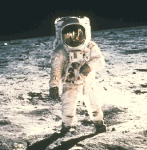 Standing on the Moon
2.02.1997
Humans once walked on the Moon. Pictured above is the second person to stand on the lunar surface: Edwin "Buzz" Aldrin. During this Apollo 11 mission, Neil Armstrong (the first person to walk on the moon) and Buzz Aldrin landed on the Moon while Michael Collins circled in the Command Module above.
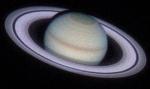 Saturn in Color
12.03.1997
Saturn is unusual but photogenic. The second largest planet in our Solar System, behind Jupiter, has been easily identifiable at night since history has been recorded. It was only with the invention of the telescope, however, that any evidence of its majestic ring system became apparent.
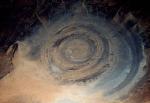 Earth's Richat Structure
5.01.1998
What on Earth is that? The Richat Structure in the Sahara Desert of Mauritania is easily visible from space because it is nearly 50 kilometers across. Once thought to be an impact crater, the Richat Structure's flat middle and lack of shock-altered rock indicates otherwise.
|
January February March April May June July August September October |
|||||||||||||||||||||||||||||||||||||||||||||||||