
|
You entered: NASA
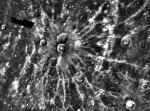 Degas Ray Crater on Mercury
8.12.1996
Like the Earth's Moon, Mercury is scarred with craters, testifying to an intense bombardment during the early history of the Solar System. In 1974, the Mariner 10 spacecraft surveyed this innermost planet up close, producing the only detailed images of its tortured surface.
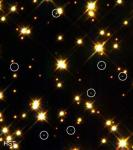 White Dwarf Stars Cool
2.11.1997
Diminutive by stellar standards, white dwarf stars are also intensely hot ... but they are cooling. No longer do their interior nuclear fires burn, so they will continue to cool until they fade away. This Hubble Space Telescope image covers a small region near the center of a globular cluster known as M4.
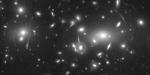 Abell 2218: A Galaxy Cluster Lens
11.01.1998
Gravity can bend light. Almost all of the bright objects in this Hubble Space Telescope image are galaxies in the cluster known as Abell 2218. The cluster is so massive and so compact that its gravity bends and focuses the light from galaxies that lie behind it.
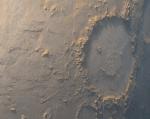 Happy Face Crater on Mars
15.03.1999
Even Mars can put on a happy face. The Martian crater Galle has internal markings reminiscent of a smiley face symbol. Such markings were originally discovered in the late 1970s in pictures taken by the Viking Orbiter. A large meteor impacted the Martian surface to form the crater.
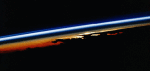 The Sun Also Rises
15.01.2000
Sunrise seen from low Earth orbit can be very dramatic indeed (and the authors don't apologize to Hemingway for using his title!). In this breathtaking view from the space shuttle Endeavor, the Sun is just visible peaking over towering anvil-shaped storm clouds.
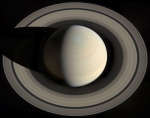 Saturn from Above
21.10.2013
This image of Saturn could not have been taken from Earth. No Earth based picture could possibly view the night side of Saturn and the corresponding shadow cast across Saturn's rings. Since Earth is much closer to the Sun than Saturn, only the day side of the ringed planet is visible from the Earth.
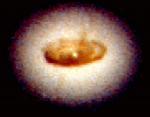 The Heart Of NGC 4261
19.10.1997
What evil lurks in the hearts of galaxies? This Hubble Space Telescope picture of the center of the nearby elliptical galaxy NGC 4261 tells one dramatic tale. The gas and dust in this disk are swirling into what is almost certainly a massive black hole.
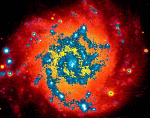 M74: A Grand Design Spiral Galaxy
9.07.1996
M74 is about the same size as our own Milky Way Galaxy. Like our Milky Way, M74 is classified a spiral galaxy. M74's sweeping lanes of stars and dust combined with its small nucleus make it a classic Grand Design Spiral. On the Hubble Sequence of Galaxies, M74 is listed as "Sc".
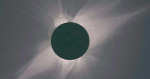 A Total Solar Eclipse
24.10.1995
Pictured above is a total solar eclipse, with the Sun's corona, clearly visible surrounding the Moon. This picture is a composite of differently exposed photos of an eclipse that occurred on July 11, 1991. Today there will be another total eclipse of the Sun, the last until March 1997.
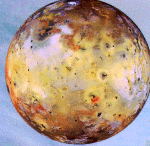 Io Full Face
29.10.1996
Io is a colorful place. The closest large moon of Jupiter, Io is the most volcanic moon in the Solar System with its surface being completely buried in volcanic lava every few thousand years.
|
January February March April May June July August September October |
|||||||||||||||||||||||||||||||||||||||||||||||||