
|
You entered: NASA
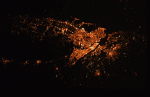 New York at Night
19.11.1995
This tantalizingly clear photo of New York City at night was taken by the astronauts during the Space Radar Laboratory mission of the Space Shuttle Endeavor in March of 1990. In this view, oriented with East up and North to the left, a dense constellation of lights defines the major metropolitan areas.
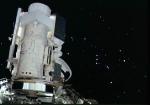 Astro 1 In Orbit
17.08.1997
In December of 1990, the Space Shuttle Columbia carried an array of astronomical telescopes high above the Earth's obscuring atmosphere to observe the Universe at ultraviolet and x-ray wavelengths. The telescopes, known...
 The Sun Also Rises
24.10.1998
Sunrise seen from low Earth orbit by the shuttle astronauts can be very dramatic indeed ( and the authors apologize to Hemingway for using his title!). In this breathtaking view, the Sun is just visible...
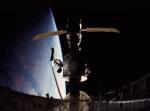 Construction of International Space Station Begins
23.02.1999
Move over Mir, here comes the International Space Station. In December 1998, the crew of Space Shuttle Endeavour started construction by joining the U.S.-built Unity node with the Russian-built Zarya module. A close look at the above IMAX(r) photograph will reveal two astronauts working on Unity.
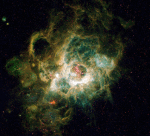 NGC 604: Giant Stellar Nursery in M33
16.08.1996
The nebula cataloged as NGC 604 is a giant star forming region, 1500 light years across, in the nearby spiral galaxy, M33. Seen here in a snapshot by the Hubble Space Telescope, over 200 newly formed, hot, massive, stars are scattered within a cavern-like, gaseous, interstellar cloud.
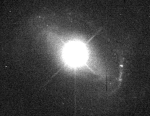 Why is QSO 1229+204 so Bright?
24.08.1996
What causes the center of this barred spiral galaxy to light up brighter than almost anything in the universe? The quasar there is a good fraction of the way across our observable universe...
 Europa's Ice Rafts
10.04.1997
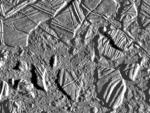
The surface of Jupiter's moon Europa has shifted. Photographs released yesterday of Europa's surface taken by the spacecraft Galileo show that the smooth moon's icy surface is sometimes like a giant scrambled jigsaw puzzle. Pieces of Europa's surface, identifiable above, have rafted to new locations.
 Dark Sky, Bright Sun
2.09.1997
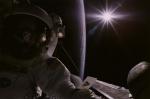
In low Earth orbit there is not enough atmosphere to diffuse and scatter sunlight, so shadows are black and the sky is dark - even when the Sun shines. The harsh lighting produced this dramatic...
 NGC 604: Giant Stellar Nursery
11.04.1998
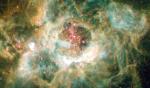
Scattered within this cavernous nebula, cataloged as NGC 604, are over 200 newly formed hot, massive, stars. At 1,500 light-years across, this expansive cloud of interstellar gas and dust is effectively a giant stellar nursery located some three million light-years distant in the spiral galaxy, M33.
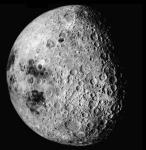 Far Side of the Moon
8.10.1998
Locked in synchronous rotation, the Moon always presents its well-known near side to Earth. But from lunar orbit, Apollo astronauts also grew to know the Moon's far side. This sharp picture from Apollo...
|
January February March April May June July August September October |
|||||||||||||||||||||||||||||||||||||||||||||||||