
|
You entered: NASA
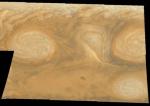 White Oval Clouds on Jupiter
8.08.1997
What are those white ovals all over Jupiter? Storms! Jupiter's clouds can swirl rapidly in raised high-pressure storm systems that circle the planet. The above pictured white ovals are located near the Great Red Spot, and have persisted on Jupiter since the 1930s. The Great Red Spot has persisted for at least 300 years.
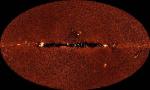 Our Dusty Universe
21.01.1998
What's black & white and red all over? Add our universe to this list. Adrift in a vast sea of darkness are not only familiar bright stars but dust that glows predominantly in far-infrared light.
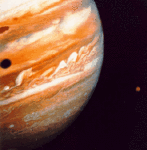 Jupiter, Io, and Ganymede's Shadow
13.10.1995
Jupiter, the solar system's largest planet, is seen here next to Io, its closest Galilean moon. On the cloud tops of Jupiter near the left edge of the picture can be seen a dark circular spot which is caused by the shadow of Jupiter's largest moon Ganymede.
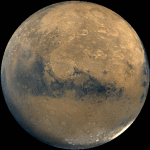 A Huge Impact Crater on Mars
3.02.1996
What hit Mars? The impact crater Schiparelli near the center of the above image was likely caused by a collision with an object the size of an asteroid. Also evident in this full face mosaic of Mars are numerous craters from many other impacts with smaller objects over billions of years.
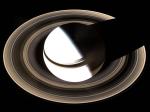 Saturn from Above
6.03.2007
This image of Saturn could not have been taken from Earth. No Earth based picture could possibly view the night side of Saturn and the corresponding shadow cast across Saturn's rings. Since Earth is much closer to the Sun than Saturn, only the day side of the planet is visible from the Earth.
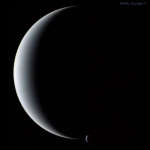 Crescent Neptune and Triton
27.05.2023
Gliding through the outer Solar System, in 1989 the Voyager 2 spacecraft looked toward the Sun to find this view of most distant planet Neptune and its moon Triton together in a crescent phase. The elegant image of ice-giant planet and largest moon was taken from behind just after Voyager's closest approach.
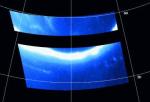 An Auroral Ring on Jupiter
9.06.1997
Do other planets have aurora? Terrestrial and spacecraft observations have found evidence for aurora on Venus, Mars, Jupiter, Saturn, Uranus, and Neptune. In the above false-color photograph, a good portion of an auroral ring was captured recently in optical light by the Galileo spacecraft in orbit around Jupiter.
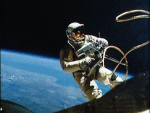 Walking in Space
15.06.1996
Pictured above is the first american astronaut to walk in space: Edward White. White is seen floating outside the Gemini 4 capsule in 1965. The term "spacewalk" is deceiving since astronauts do not actually walk - they float - usually without their feet touching anything solid. White was connected to the spaceship only by a thick tether.
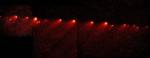 A String Of Pearls
23.03.1997
Comet Shoemaker-Levy 9, named after its co-discoverers, was often referred to as the "string of pearls" comet. It is famous for its unusual appearance as well as its collision with the planet Jupiter!
 Surveyor Slides
9.11.1997
"Safe!" In September 1967 (during regular season play), the Surveyor 5 lander actually slid several feet while making a successful soft landing on the Moon's Mare Tranquillitatis. Equipped with television cameras and soil...
|
January February March April May June July August September October |
|||||||||||||||||||||||||||||||||||||||||||||||||