
|
You entered: NASA
 The Night Shift
17.12.1998
For the orbiting International Space Station (ISS), the sun sets every 90 minutes. But working through the night, spacewalking astronauts can rely on artificial lighting. Here, the eerie glow of work-lights illuminate Space Shuttle Endeavor astronaut Jerry Ross during a night on his
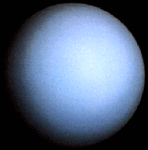 Uranus: The Tilted Planet
16.08.1995
This picture was snapped by the Voyager 2 spacecraft in 1986 - the only spacecraft ever to visit Uranus. Uranus is the third largest planet after Jupiter and Saturn. Uranus has many moons and a ring system.
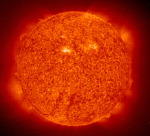 A Winter Solstice
21.12.1997
Today is the Winter Solstice, the shortest day of the year in the Northern Hemisphere. The yearly cycle of Seasons on planet Earth once again finds the Sun at its lowest point in the Northern Sky.
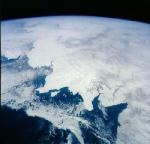 Water World
30.05.1998
Water (Dihydrogen Oxide, H2O) is a truly remarkable chemical compound, fundamental to life on Earth. Earth is the only planet in the Solar System where the present surface temperature and pressure allow the three forms of water, solid (ice), liquid (ocean), and gas (water vapor condensing in clouds) to exist simultaneously.
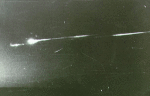 A Meteoric View of Apollo 13
9.07.1995
Meteors, also called shooting stars, normally begin as bits of dust from the tails of comets or even small pieces chipped off asteroids. Falling toward Earth, these particles enter the atmosphere at extremely high speeds. Friction with the air heats them up and makes them glow brightly.
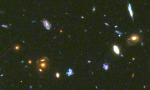 Distant Galaxies
7.09.1995
This Hubble Space Telescope image of a group of faint galaxies "far, far away" is a snap shot of the Universe when it was young. The bluish, irregularly shaped galaxies revealed in the image are up to eight billion light years away and seem to have commonly undergone galaxy collisions and bursts of star formation.
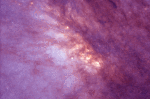 Central Galactic Star Bursts
1.10.1995
The pictured core of the galaxy NGC 253 shows an exceptionally high rate of star formation. In the center are some of the densest knots of stars ever found, surrounded by glowing gas and dust lanes. Galaxies where such high star formation rates are seen are called "starburst" galaxies.
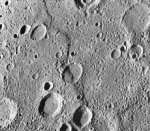 Mercury's Faults
21.01.1996
The surface of the planet Mercury is not without fault. In this case, however, "fault" refers to unusual surface features that are the topic of much speculation. The above fault line is called Santa Maria Rupes, and runs through many prominent craters.
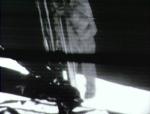 Apollo 11: Onto a New World
19.05.1998
A human first set foot on another world on July 20, 1969. This world was Earth's own Moon. Pictured above is Neil Armstrong preparing to take the historic first step. On the way down the Lunar Module ladder, Armstrong released equipment which included the television camera that recorded this fuzzy image.
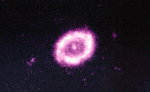 Starburst Galaxy M94
16.10.1995
The spiral galaxy M94 is somewhat unusual in that it shows a great ring of bright young stars particularly apparent when observed in ultraviolet light, as shown above. Such a high abundance of these young blue stars may cause a galaxy to be designated a starburst galaxy.
|
January February March April May June July August September October |
|||||||||||||||||||||||||||||||||||||||||||||||||