
|
You entered: NASA
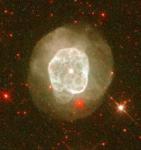 Nebulae For Christmas
25.12.1998
If our Galaxy were a Christmas tree, planetary nebulae would adorn it like colorful lighted ornaments twinkling on a cosmic scale. Glowing shrouds of gas ejected by red giant stars, planetary nebulae like...
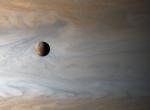 Io: Moon Over Jupiter
6.07.2002
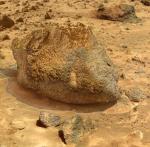 Yogi Rock on Mars
9.03.1998
Yogi is possibly the best photographed rock on Mars. By combining many pictures taken during the Mars Pathfinder Mission last year, scientists were able to create a super-resolution, digitally enhanced image that better allows them to study Yogi's surface and more accurately determine how Yogi was formed.
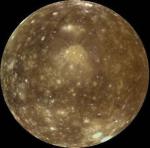 Callisto in True Color
11.05.1998
Callisto's surface has many stories to tell. The most distant of Jupiter's Galilean Moons, Callisto shows the highest density of impact craters in the Solar System, but harbors no volcanoes or even any large mountains. Callisto's surface is laced with cracks and craters from
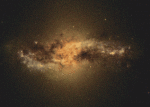 Arp 230: Two Spirals in One?
22.08.1996
Is this one galaxy or two? Analysis of Arp 230 has shown evidence that this seemingly single spiral galaxy is actually the result of the recent collision of two spiral galaxies. The slow motion collision took place over about 100 million years and induced a burst of star formation that has begun to subside.
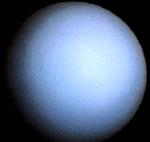 Uranus: The Tilted Planet
15.11.1997
Uranus is the third largest planet after Jupiter and Saturn. This picture was snapped by the Voyager 2 spacecraft in 1986 - the only spacecraft ever to visit Uranus. Uranus has many moons and a ring system. Uranus is composed mostly of rock and ices, but with a thick hydrogen and helium atmosphere.
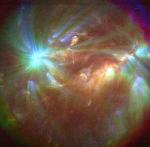 Sun Dance
11.08.1998
Hot gas dances across the surface of the Sun in this picture from the orbiting TRACE satellite. The temperature of the gas is color coded so that blue represents hundreds of thousands of Kelvin, while red represents extreme temperatures in the millions of Kelvin.
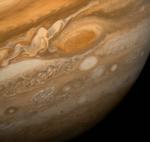 Jupiter from Voyager
18.07.1999
This picture of the planet Jupiter was taken by the Voyager 1 spacecraft as it passed the planet in 1979. Jupiter, a gas giant planet with no solid surface, is the largest planet in the Solar System and is made mostly of the hydrogen and helium.
 Neptune's Moon Proteus
4.11.1995
Proteus is the second largest moon of Neptune behind the mysterious Triton. Proteus was discovered only in 1982 by the Voyager 2 spacecraft. This is unusual since Neptune has a smaller moon - Nereid - which was discovered 33 years earlier from Earth.
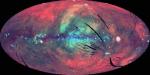 ROSAT Explores The X-Ray Sky
19.08.2000
Launched in 1990, the orbiting ROSAT observatory explored the Universe by viewing the entire sky in x-rays -- photons with about 1,000 times more energy than visible light. This ROSAT survey produced the sharpest, most sensitive image of the x-ray sky to date.
|
January February March April May June July August September October |
|||||||||||||||||||||||||||||||||||||||||||||||||