
|
You entered: NASA
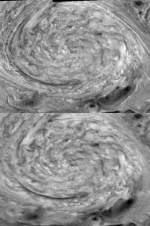 A New Jupiter Oval Rotates
5.01.1999
Even Jupiter can do the twist. Large cloud systems on Jupiter rotate, and the newly formed oval pictured above is no different. This new oval formed earlier this year from the collision of two smaller ovals: an occurrence not unlike two large storms merging into one huge hurricane.
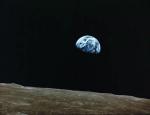 The Millennium that Defined Earth
31.12.1999
When the second millennium began, people generally knew that the Earth was round, but few saw much of it beyond their local village. As the millennium progressed, humans mapped the continents, circumnavigated the globe, and determined the composition of the Earth.
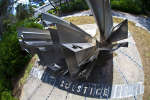 A Sundial that Shows Solstice
26.06.2012
What time is it? If the time and day are right, this sundial will tell you: SOLSTICE. Only then will the Sun be located just right for sunlight to stream through openings and spell out the term for the longest and shortest days of the year. And that happened last week and twice each year.
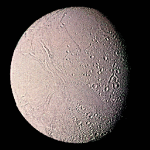 Saturn's Cleanest Moon: Enceladus
25.11.1995
Enceladus orbits Saturn between the smaller Mimas and the larger Tethys. Enceladus is composed mostly of water ice and has the cleanest and purest ice surface in the Solar System. It's surface therefore appears nearly white. The surface also has many unusual groves and relatively few craters, like Jupiter's moon Ganymede.
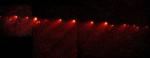 A String Of Pearls
1.08.1998
Comet Shoemaker-Levy 9, named after its co-discoverers, was often referred to as the "string of pearls" comet. It is famous for its suggestive appearance as well as its collision with the planet Jupiter!
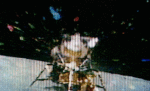 Blasting Off from the Moon
13.12.1998
How did the astronauts get back from the Moon? The Lunar Module that landed two astronauts on the Moon actually came apart. The top part containing the astronauts carried additional rocket fuel which allowed it to blast away, leaving the bottom part on the Moon forever.
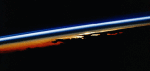 The Sun Also Rises
17.11.1995
Sunrise seen from low Earth orbit by the shuttle astronauts can be very dramatic indeed (and the authors apologize to Hemingway for using his title!). In this breathtaking view, the Sun is just visible...
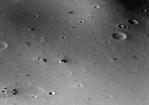 18 Miles From Deimos
22.12.1996
Diminutive Deimos is the smallest of the two tiny Moons of Mars. Potato shaped and barely 6 miles wide this asteroid-like body was visited by the Viking 2 orbiter in 1977. This image was made when the spacecraft approached to within 18 miles of Deimos' surface.
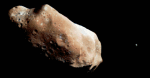 Ida and Dactyl: Asteroid and Moon
29.06.1997
This asteroid has a moon! The robot spacecraft Galileo currently exploring the Jovian system, encountered and photographed two asteroids during its long journey to Jupiter. The second asteroid it photographed, Ida, was discovered to have a moon which appears as a small dot to the right of Ida in this picture.
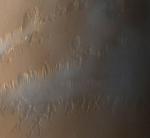 Mars: A Mist In Mariner Valley
17.10.1997
An icy mist and late afternoon clouds cover much of this section of Valles Marineris on Mars. The Valles Marineris or Mariner Valley is a huge canyon system about 2,000 miles long and up to 5 miles deep.
|
January February March April May June July August September October |
|||||||||||||||||||||||||||||||||||||||||||||||||