
|
You entered: NASA
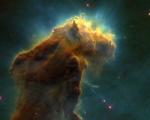 Eagle Eggs in M16
27.02.1998
Star forming regions known as "EGGs" are uncovered at the end of this giant pillar of gas and dust in the Eagle Nebula (M16). EGGs, short for evaporating gaseous globules, are dense regions of mostly molecular hydrogen gas that fragment and gravitationally collapse to form stars.
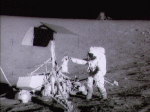 Apollo 12 Visits Surveyor 3
7.10.1995
Apollo 12 was the second mission to land humans on the Moon. The landing site was picked to be near the location of Surveyor 3, a robot spacecraft that had landed on the moon three years earlier. Pictured above, Apollo 12 astronauts Conrad and Bean retrieve parts from the Surveyor.
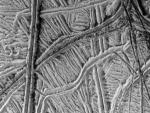 Cracks and Ridges on Europa
9.03.1998
Which way to the interstate? What appears to be a caricature of a complex highway system on Earth is actually a system of ridges and cracks on the icy surface of Jupiter's moon Europa. The distance between parallel ridges in the above photograph is typically about 1 kilometer.
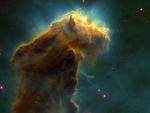 Eagle EGGs in M16
2.04.2000
Star forming regions known as "EGGs" are uncovered at the end of this giant pillar of gas and dust in the Eagle Nebula (M16). EGGs, short for evaporating gaseous globules, are dense regions of mostly molecular hydrogen gas that fragment and gravitationally collapse to form stars.
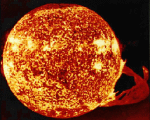 The Sun Erupts
13.08.1995
The sun was captured in 1973 throwing one of the largest eruptive prominences ever recorded. Sol, our sun, is a normal star. It formed about 5 billion years ago, and will last about another 5 billion years. The sun will never explode, and a solar flare will never destroy the earth.
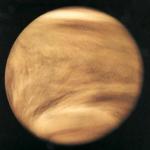 Ultraviolet Venus
7.05.1997
The forecast for Venus is cloudy, cloudy, cloudy. Although similar to the Earth in size and mass, Venus' slightly closer orbit to the Sun create for it a much thicker atmosphere and a much hotter surface. The thick atmosphere was photographed above in ultraviolet light in 1979 by the Pioneer Venus Orbiter.
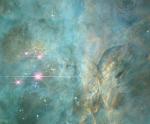 In the Center of the Trapezium
17.11.1997
Start with the constellation of Orion. Below Orion's belt is a fuzzy area known as the Great Nebula of Orion or M42. In this nebula is a bright star cluster known as the Trapezium, shown above. New stellar systems are forming there in gigantic globs of gas and dust known as Proplyds.
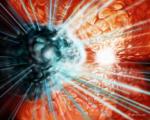 Lasers in Eta Carinae
28.11.1997
Have you heard about the great LASER light show in the sky? A team led by K. Davidson (U. Michigan) and S. Johansson (U. Lund) discovered that the chaotically variable star Eta Carinae emits ultraviolet light in such a narrow band that it is most probably LASER light!
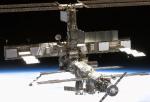 The International Space Station from Orbit
16.08.2005
The International Space Station (ISS) is the largest human-made object ever to orbit the Earth. Late last month and earlier this month, the station was visited and resupplied by space shuttle Discovery. The ISS is currently operated by the Expedition 11 crew, consisting a Russian and an American astronaut.
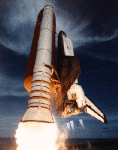 Challenger Launches Spacelab 2
9.08.1995
Space Shuttle Challenger jumps off the launch pad in 1985 to begin a successful mission. The main purpose of this mission was to test a new space based laboratory named Spacelab 2. Spacelab...
|
January February March April May June July August September October |
|||||||||||||||||||||||||||||||||||||||||||||||||