
|
You entered: NASA
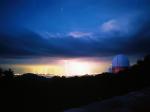 Lightning on Earth
18.08.2004
Nobody knows what causes lightning. It is known that charges slowly separate in some clouds causing rapid electrical discharges (lightning), but how electrical charges get separated in clouds remains a topic of much research.
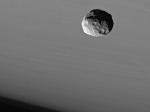 Janus: Potato Shaped Moon of Saturn
7.11.2006
Janus is one of the stranger moons of Saturn. First, Janus travels in an unusual orbit around Saturn where it periodically trades places with its sister moon Epimetheus, which typically orbits about 50 kilometers away. Janus, although slightly larger than Epimetheus, is potato-shaped and has a largest diameter of about 190 kilometers.
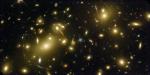 Abell 2218: A Galaxy Cluster Lens
1.02.2000
Gravity can bend light. Almost all of the bright objects in this recently released Hubble Space Telescope image are galaxies in the cluster known as Abell 2218. The cluster is so massive and so compact that its gravity bends and focuses the light from galaxies that lie behind it.
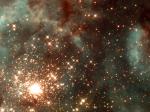 Star Cluster R136 Bursts Out
6.05.2007
In the center of star-forming region 30 Doradus lies a huge cluster of the largest, hottest, most massive stars known. These stars, known as the star cluster R136, and part of the surrounding nebula are captured here in this gorgeous visible-light image from the Hubble Space Telescope.
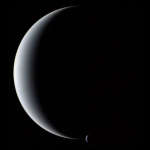 Crescent Neptune and Triton
13.12.2009
Gliding silently through the outer Solar System, the Voyager 2 spacecraft camera captured Neptune and Triton together in crescent phase in 1989. The above picture of the gas giant planet and its cloudy moon was taken from behind just after closest approach.
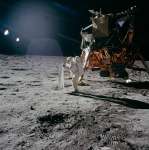 Apollo 11: Catching Some Sun
22.07.2017
Bright sunlight glints and long dark shadows mark this image of the lunar surface. It was taken July 20, 1969 by Apollo 11 astronaut Neil Armstrong, the first to walk on the Moon. Pictured...
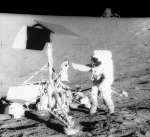 Apollo 12 Visits Surveyor 3
22.10.2018
Apollo 12 was the second mission to land humans on the Moon. The landing site was picked to be near the location of Surveyor 3, a robot spacecraft that had landed on the Moon three years earlier.
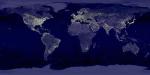 Earth at Night
27.11.2000
This is what the Earth looks like at night. Can you find your favorite country or city? Surprisingly, city lights make this task quite possible. Human-made lights highlight particularly developed or populated areas of the Earth's surface, including the seaboards of Europe, the eastern United States, and Japan.
 The Cygnus Loop
26.07.1996
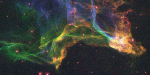
15,000 years ago a star in the constellation of Cygnus exploded -- the shockwave from this supernova explosion is still expanding into interstellar space! The collision of this fast moving wall of gas with...
 Dust Hip Deep on Phobos
14.09.1998
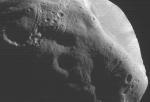
Landing on the Martian Moon Phobos might be harder than previously thought. The reason: Moon dust. Recent photographs of Phobos have indicated that a layer of fine powder estimated to be a meter deep covers the whole surface. Evidence comes from infrared pictures that indicate the rapid speed that Phobos' surface cools after sunset.
|
January February March April May June July August September October |
|||||||||||||||||||||||||||||||||||||||||||||||||