
|
You entered: NASA
 Crescent Neptune and Triton
19.06.2001
Gliding silently through the outer Solar System, the Voyager 2 spacecraft camera captured Neptune and Triton together in crescent phase in 1989. The above picture of the gas giant planet and its cloudy moon was taken from behind just after closest approach.
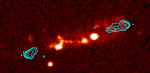 An Energetic Radio Galaxy
30.09.1995
The radio and optical emission seen in the above superposed images of the radio galaxy 3C368 indicate that energetic processes are at work. A radio galaxy is a galaxy that is visible to radio telescopes. A large radio signal usually indicates very powerful phenomena.
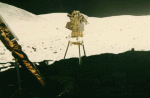 The First Lunar Observatory
8.06.1996
The first and only lunar astronomical observatory was deployed by the Apollo 16 crew in 1972. The Far Ultraviolet Camera / Spectrograph used a 3-inch diameter telescope to photograph the Earth, various nebulae, star clusters, and the Large Magellanic Cloud.
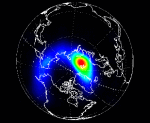 X-Ray Earth
30.12.1996
The Earth glows in many kinds of light, including the energetic X-ray band. Actually, the Earth itself does not glow - only aurora produced high in the Earth's atmosphere. Above is the first picture of the Earth in X-rays, taken in March with the orbiting Polar satellite. Bright X-ray emission is shown in red.
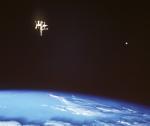 The Moons Of Earth
13.08.1998
While orbiting the planet during their June 1998 mission, the crew of the Space Shuttle Discovery photographed this view of two moons of Earth. Thick storm clouds are visible in the lovely blue planet...
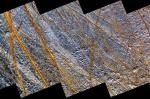 Plains and Ridges on Europa
15.12.1998
The ridges on Europa may be caused by cold water volcanoes. Europa, one of the largest moons of Jupiter, has been the source of intense scrutiny since speculation increased of there being oceans beneath its icy surface.
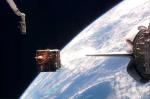 Deploying Spartan
12.08.1999
Last October the Space Shuttle Discovery deployed Spartan 201, a spacecraft that monitored the corona of the Sun. Instruments on Spartan 201 were used to estimate the density of electrons emitted into the solar...
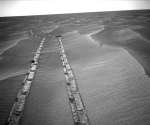 Looking Back Across Mars
25.05.2010
It's been a long trip for the Martian rover Opportunity. Last week Opportunity surpassed Viking 1 as the longest running mission on Mars, now extending well over six years. Pictured above, Opportunity's tire tracks cross a nearly featureless Martian desert, emanating from a distant horizon.
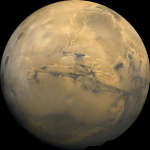 Valles Marineris: The Grand Canyon of Mars
27.03.2011
The largest canyon in the Solar System cuts a wide swath across the face of Mars. Named Valles Marineris, the grand valley extends over 3,000 kilometers long, spans as much as 600 kilometers across, and delves as much as 8 kilometers deep.
 Lunar Shadow Transit
11.03.2016
This snapshot from deep space captures planet Earth on March 9. The shadow of its large moon is falling on the planet's sunlit hemisphere. Tracking toward the east (left to right) across the ocean-covered world the moon shadow moved quickly in the direction of the planet's rotation.
|
January February March April May June July August September October |
|||||||||||||||||||||||||||||||||||||||||||||||||