
|
You entered: NASA
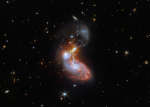 Merging Galaxy Pair IIZw096
2.12.2022
Bright at infrared wavelengths, this merging galaxy pair is some 500 million light-years away toward the constellation Delphinus. The cosmic mashup is seen against a background of even more distant galaxies, and occasional spiky foreground stars. But the galaxy merger itself spans about 100,000 light-years in this deep James Webb Space Telescope image.
 Apollo 11: Catching Some Sun
29.07.2023
Bright sunlight glints as long dark shadows mark this image of the surface of the Moon. It was taken fifty-four years ago, July 20, 1969, by Apollo 11 astronaut Neil Armstrong, the first to walk on the lunar surface. Pictured is the mission's lunar module, the Eagle, and spacesuited lunar module pilot Buzz Aldrin.
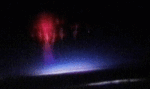 Red Sprite Lightning
11.11.1995
Recently two new types of lightning have been verified: red sprites and blue jets. These atmospheric discharges occur very high in the Earth's atmosphere - much higher than the familiar form of lightning.
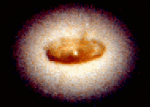 The Swirling Center of NGC 4261
5.12.1995
What evil lurks in the hearts of galaxies? The above picture by the Hubble Space Telescope of the center of the nearby galaxy NGC 4261 tells us one dramatic tale. Here gas and dust are seen swirling near this elliptical galaxy's center into what is almost certainly a massive black hole.
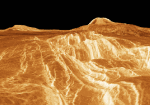 A View from Venus: Rift Valley
24.06.1996
Color information from the Soviet Venera landers and radar data from the Magellan spacecraft were used to construct this striking perspective view of the Venusian landscape. (In this computer generated image, the vertical scale has been exagerated.) In the foreground is the edge of a rift valley created by faulting in the crust of Venus.
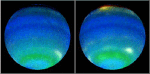 The Weather on Neptune
28.10.1996
Today's weather on Neptune will be typical. Highs in the upper atmosphere will be about -150 Centigrade, with winds ranging about 900 miles per hour near the equator. Much was learned recently about Neptune's weather by the release last week of time-lapse pictures of the most distant gas giant in our Solar System.
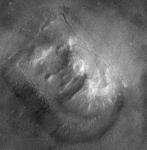 Return To Cydonia
7.04.1998
Yesterday the Mars Global Surveyor project released a new close-up image of a portion of the Cydonia region on Mars. This cropped and processed version shows an area about 2 miles wide (the full...
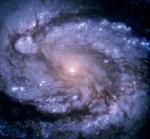 M100: A Grand Design
6.06.1998
Majestic on a truly cosmic scale, M100 is appropriately known as a Grand Design spiral galaxy. A large galaxy of over 100 billion or so stars with well defined spiral arms, it is similar to our own Milky Way.
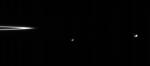 Epimetheus and Janus: Interchangeable Moons of Saturn
2.11.2005
These two moons change places. Epimetheus and Janus, two small moons of Saturn, actually switch positions as they orbit their home planet. The orbital radii of the moons are strangely separated by less than the radii of the moons themselves: about 50 kilometers. One moon orbits Saturn well ahead of the other, at first.
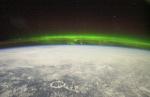 Aurora from Space
5.11.2005
From the ground, spectacular auroras seem to dance high above. But the International Space Station (ISS) orbits at nearly the same height as many auroras, sometimes passing over them, and sometimes right through them. Still, the auroral electron and proton streams pose no direct danger to the ISS.
|
January February March April May June July August September October |
|||||||||||||||||||||||||||||||||||||||||||||||||