
|
You entered: NASA
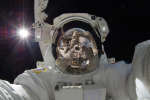 Orbiting Astronaut Self Portrait
18.09.2012
Is it art? Earlier this month, space station astronaut Aki Hoshide (Japan) recorded this striking image while helping to augment the capabilities of the Earth-orbiting International Space Station (ISS). Visible in this outworldly assemblage...
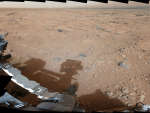 Mars: Shadow at Point Lake
5.02.2013
What if you saw your shadow on Mars and it wasn't human? Then you might be the robotic Curiosity rover currently exploring Mars. Curiosity landed in Gale Crater last August and has been busy looking for signs of ancient running water and clues that Mars could once have harbored life.
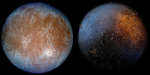 Moon or Frying Pan
1.04.2013
Which is which? Of the two images shown above, one is a moon in our Solar System, while the other is the bottom of frying pan. We are not making this up -- can you tell a pan from a planetoid? Think you got it? To find the answer click here. OK, but there are more!
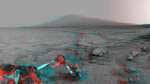 Sharp Stereo
27.04.2013
Get out your red/blue glasses and gaze across the floor of Gale crater on Mars. From your vantage point on the deck of the Curiosity Rover Mount Sharp, the crater's 5 kilometer high central mountain looms over the southern horizon.
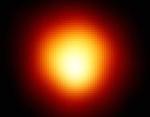 Betelgeuse, Betelgeuse, Betelgeuse
5.06.1999
Betelgeuse (sounds a lot like "beetle juice"), a red supergiant star about 600 light years distant, is seen in this Hubble Space Telescope image - the first direct picture of the surface of a star other than the Sun. While Betelgeuse is cooler than the Sun, it is more massive and over 1000 times larger.
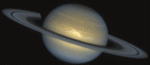 A Storm on Saturn
18.10.1995
The white wisp shown on Saturn's cloud tops is actually a major storm system only discovered in December of 1994. Saturn's clouds are composed of primarily hydrogen and helium, but the storm's white clouds are actually ammonia ice crystals that have frozen upon upheaval to the top of the atmosphere.
 The Leonid Meteor Shower (Tonight)
16.11.1996
Tonight thousands of icy rocks will hurl toward Earth in a fascinating display of light called the Leonid Meteor Shower. There is little danger - few will reach the ground. But this year's Leonids could be nothing compared to the Leonids in 1998.
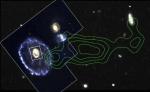 The Trail of the Intruder
24.02.1997
In yesterday's episode our hero, the Cartwheel galaxy, had survived a chance cosmic collision with a small intruder galaxy - triggering an expanding ring of star formation. Hot on the intruder's trail, a team of multiwavelength sleuths have compiled evidence tracking the reckless galaxy fleeing the scene.
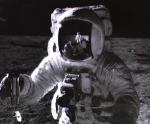 Apollo 12: Self-Portrait
9.05.1997
Is it art? In November of 1969, Apollo 12 astronaut-photographer Charles "Pete" Conrad recorded this masterpiece while documenting colleague Alan Bean's lunar soil collection activities on the Oceanus Procellarum. The image is dramatic and stark.
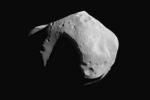 NEAR Mathilde
30.06.1997
Hey Earth, look what I found! On the way to visiting the asteroid 433 Eros in February 1999, the Near Earth Asteroid Rendezvous (NEAR) spacecraft flew right by another asteroid: 253 Mathilde last Friday. Shown above is one picture from the encounter.
|
January February March April May June July August September October |
|||||||||||||||||||||||||||||||||||||||||||||||||