
|
You entered: NASA
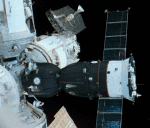 A Soyuz at Mir
28.09.1996
Pictured above is a three person Russian Soyuz capsule with wing-like solar panels extended, joined to the Mir space station. In Russian soyuz means "union" and indeed one of the milestones achieved by a Soyuz spacecraft was an orbital union with a US Apollo command module during the first international space mission (Apollo-Soyuz) in 1975.
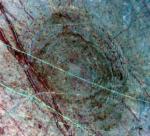 Impact on Europa
15.08.1997
This bull's-eye pattern marks the impact of a mountain-sized comet or asteroid on the icy surface of Jupiter's moon Europa. Recorded by the Galileo spacecraft in April of this year, the composite false color image clearly reveals the telltale concentric fractures which cover about
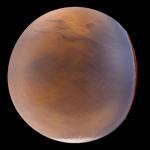 All of Mars
10.02.1998
Mars Global Surveyor is photographing Mars. The robot spacecraft arrived last September and continues to use solar panel aerobraking to help maneuver it to a better orbit to survey all of Mars The above image is a reconstruction of several photographs digitally combined to simulate a single vantage point 2700 kilometers above the Martian surface.
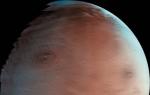 Good Morning Mars
19.06.1998
Looking down on the Northern Hemisphere of Mars on June 1, the Mars Global Surveyor spacecraft's wide angle camera recorded this morning image of the red planet. Mars Global Surveyor's orbit...
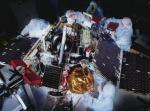 Invader From Earth
8.01.1999
These technicians are working on the solar-paneled Mars Polar Lander - yet another robotic spacecraft scheduled to invade the red planet. Mars Polar Lander is part of a series of missions focusing on a search for evidence of past or present life.
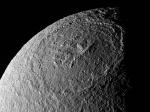 The Great Basin on Tethys
8.02.2006
Some moons wouldn't survive the collision. Tethys, one of Saturn's larger moons at about 1000 kilometers in diameter, survived the collision, but sports today the expansive impact crater Odysseus. Sometimes called...
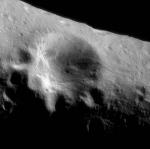 Nearer To Asteroid Eros
8.03.2000
As the robot spacecraft NEAR lowers itself toward asteroid 433 Eros, more surface details are becoming visible. Last week's maneuvers brought NEAR to within 204 kilometers of the floating mountain's surface. With...
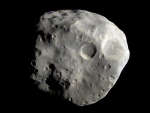 Saturns Moon Epimetheus from the Cassini Spacecraft
11.02.2008
How did Epimetheus form? No one is yet sure. To help answer that question, this small moon has recently been imaged again in great detail by the robot spacecraft Cassini now orbiting Saturn. Epimetheus sometimes orbits Saturn in front of Janus, another small satellite, but sometimes behind.
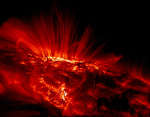 Sunspot Loops in Ultraviolet
10.04.2011
It was a quiet day on the Sun. The above image shows, however, that even during off days the Sun's surface is a busy place. Shown in ultraviolet light, the relatively cool dark regions have temperatures of thousands of degrees Celsius.
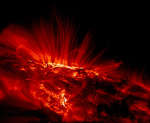 Sunspot Loops in Ultraviolet
26.01.2014
It was a quiet day on the Sun. The above image shows, however, that even during off days the Sun's surface is a busy place. Shown in ultraviolet light, the relatively cool dark regions have temperatures of thousands of degrees Celsius.
|
January February March April May June July August September October |
|||||||||||||||||||||||||||||||||||||||||||||||||