
|
You entered: NASA
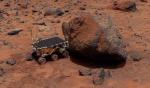 Mars Rocks, Sojourner Rolls
14.08.1997
This sharp color image featuring Mars rock Yogi and the rolling Sojourner robot shows off Yogi's startling two-toned surface. Yogi appears to be leaning into the prevailing winds causing some to suggest that its color contrast may be caused by the accumulation of rust colored dust on its windward face.
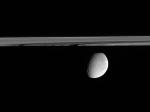 Slightly Beneath Saturns Ring Plane
5.04.2006
When orbiting Saturn, be sure to watch for breathtaking superpositions of moons, rings, and shadows. One such picturesque vista was visible recently to the robot Cassini spacecraft now orbiting Saturn. In late February, Cassini captured a Rhea, the second largest moon of Saturn, while looking up from slightly beneath Saturn's expansive ring plane.
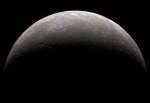 Crescent Mercury in Color
26.01.2008
Hard to spot against the twilight glow near planet Earth's horizon, a crescent Mercury was imaged close up by the MESSENGER spacecraft early last week. Colors in this remarkable picture were created using data recorded through infrared, red, and violet filters.
 Bonestell Panorama from Mars
20.01.2009
If you could stand on Mars -- what could you see? One memorable vista might be the above 360-degree panoramic image taken by the robotic Spirit rover over the last year. The above image involved over 200 exposures and was released as part of Spirit's five year anniversary of landing on the red planet.
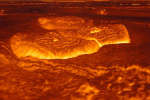 Venus Once Molten Surface
1.08.2010
If you could look across Venus with radar eyes, what might you see? This computer reconstruction of the surface of Venus was created from data from the Magellan spacecraft. Magellan orbited Venus and used radar to map our neighboring planet's surface between 1990 and 1994.
 Venus at the Edge
9.06.2012
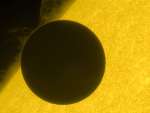
As its June 6 2012 transit begins Earth's sister planet crosses the edge of the Sun in this stunning view from the Hinode spacecraft. The timing of limb crossings during the rare transits was used historically to triangulate the distance to Venus and determine a value for the Earth-Sun distance called the astronomical unit.
 Messier 77
10.05.2013
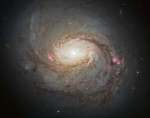
Face-on spiral galaxy M77 lies a mere 47 million light-years away toward the aquatic constellation Cetus. At that estimated distance, the gorgeous island universe is about 100 thousand light-years across. Also known...
 Venus Once Molten Surface
23.06.2013
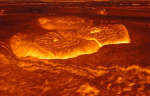
If you could look across Venus with radar eyes, what might you see? This computer reconstruction of the surface of Venus was created from data from the Magellan spacecraft. Magellan orbited Venus and used radar to map our neighboring planet's surface between 1990 and 1994.
 Apollo 17 at Shorty Crater
24.11.2017
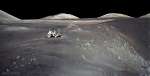
In December of 1972, Apollo 17 astronauts Eugene Cernan and Harrison Schmitt spent about 75 hours on the Moon in the Taurus-Littrow valley, while colleague Ronald Evans orbited overhead. This sharp image was taken by Cernan as he and Schmitt roamed the valley floor.
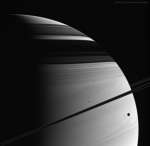 Moons, Rings, Shadows, Clouds: Saturn (Cassini)
2.04.2018
While cruising around Saturn, be on the lookout for picturesque juxtapositions of moons, rings, and shadows. One quite picturesque arrangement occurred in 2005 and was captured by the then Saturn-orbiting Cassini spacecraft. In the featured image, moons Tethys and Mimas are visible on either side of Saturn's thin rings, which are seen nearly edge-on.
|
January February March April May June July August September October |
|||||||||||||||||||||||||||||||||||||||||||||||||