
|
You entered: NASA
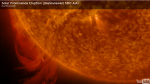 A Huge Solar Filament Erupts
31.07.2016
Filaments sometimes explode off the Sun. Featured, a huge filament had been seen hovering over the Sun's surface for over a week before it erupted late in 2010. The image sequence was taken by the Earth-orbiting Solar Dynamics Observatory (SDO) in one color of ultraviolet light.
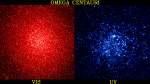 Globular Cluster Omega Centauri
4.10.1996
Does an old, red globular cluster have any hot, blue stars? The rightmost picture, taken by the Ultraviolet Imaging Telescope in ultraviolet light, shows that indeed it does. Pictured, Omega Centauri is the largest known globular cluster in our Galaxy, containing well over a million stars.
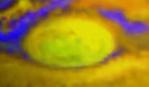 Jupiter: The Great Yellow Spot
11.03.1997
What happened to Jupiter's Great Red Spot? Operating at a chilly 55 degrees Kelvin, the Galileo Spacecraft's Near Infrared Mapping Spectrometer (NIMS) recorded this composite image of Jupiter's Great Red Spot in late June 1996.
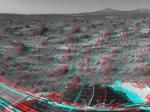 Mars: Twin Peaks In Stereo
14.07.1997
Get out your red/blue glasses and gaze across the surface of Mars in stereo. You are looking south of west across an ancient flood channel, Ares Vallis, landing site of the Mars Pathfinder.
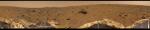 A Presidential Panorama of Mars
22.07.1997
Scroll right to unfold the latest panorama of the surface of Mars. For best viewing, click and hold on the right arrow icon at the bottom of your browser window. This image, released yesterday and dubbed a "presidential panorama" by the Mars Pathfinder team, shows in colorful detail the surroundings of the Sagan Memorial Station.
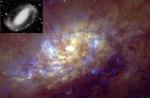 Starbirth in NGC 1808
23.03.1998
The center of galaxy NGC 1808 is bursting with new stars, but why? Being a barred spiral galaxy makes NGC 1808 somewhat similar to our own Milky Way Galaxy. But the disk of NGC 1808 (inset) is quite warped, and its center is unusually bright and blue.
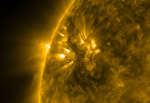 Dark Filament of the Sun
22.05.2010
Suspended by magnetic fields above a solar active region this dark filament stretches over 40 earth-diameters. The ominous structure appears to be frozen in time near the Sun's edge, but solar filaments are unstable and often erupt.
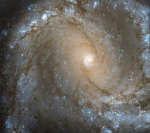 In the Center of Spiral Galaxy M61
20.05.2014
M61 is a barred spiral galaxy located in the nearby Virgo Cluster of Galaxies. Visible in M61 are a host of features common to spiral galaxies: bright spiral arms, a central bar, dust lanes, and bright knots of stars. M61, also known as NGC 4303, in similar to our own Milky Way Galaxy.
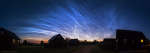 Veins of Heaven
31.07.2014
Transfusing sunlight through a a still dark sky, this exceptional display of noctilucent clouds was captured earlier this month above the island of Gotland, Sweden. From the edge of space, about 80 kilometers above...
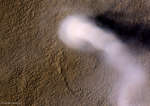 A Dust Devil on Mars
2.03.2015
It was late in the northern martian spring when the HiRISE camera onboard the Mars Reconnaissance Orbiter spied this local denizen. Tracking across the flat, dust-covered Amazonis Planitia in 2012, the core of this whirling dust devil is about 140 meters in diameter.
|
January February March April May June July August September October |
|||||||||||||||||||||||||||||||||||||||||||||||||