
|
You entered: NASA
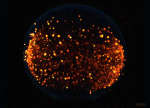 Fire in Space
10.08.2021
What does fire look like in space? In the gravity on Earth, heated air rises and expands, causing flames to be teardrop shaped. In the microgravity of the air-filled International Space Station (ISS), however, flames are spheres.
 Pluto at Night
26.03.2022
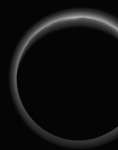
The night side of Pluto spans this shadowy scene. In the stunning spacebased perspective the Sun is 4.9 billion kilometers (almost 4.5 light-hours) behind the dim and distant world. It was captured...
 Pluto at Night
16.11.2024
The night side of Pluto spans this shadowy scene. In the stunning spacebased perspective the Sun is 4.9 billion kilometers (almost 4.5 light-hours) behind the dim and distant world. It was captured...
 Anticrepuscular Rays over Sicily
25.06.2026
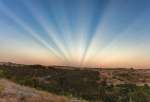
The Sun has just set... in the opposite side of the sky. Pictured here are anticrepuscular rays apparently converging in the east in this image of the limestone plateau in the heart of the Hyblaean Mountains of southeastern Sicily, in Italy. How were these anticrepuscular rays formed, if the Sun wasn't there?
 Tanks for the Lift
24.02.1996
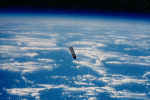
Sixteen minutes after the liftoff of STS-29, the Space Shuttle Discovery's jettisoned External Tank (ET) is seen here, in a photograph by shuttle astronaut James P. Bagian, falling back towards Earth. The 154 foot long ET is the largest non-reusable component in the Shuttle system.
 GRB970228: What's There?
7.04.1997
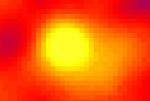
Could this fuzzy blob be the key to the whole gamma-ray burst (GRB) mystery? Astronomers the world over are now scrambling to determine the true nature of the extended emission seen to the lower right of the bright source in the above image.
 A Map of Asteroid Vesta
8.09.1997
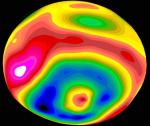
Vesta is a huge rock 500 kilometers across that orbits out past Mars. Last week, the above map of Vesta created using the Hubble Space Telescope was released showing a rugged surface highlighted by a single crater spanning nearly the entire length of the asteroid.
 The Hubble 5 Planetary Nebula
19.01.1998
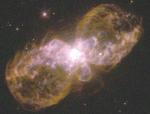
The Hubble Double Bubble Planetary Nebula is bubbling over with excitement. More mundanely known as Hubble 5, this bipolar planetary nebula is being created by a hot wind of particles streaming away from the central star system.
 Supernova Remnant E0102 from Hubble
29.08.2006
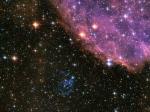
It's the blue wisp near the bottom that's the remnant of a tremendous recent supernova explosion. The large pink structure looming to the upper right is part of N76, a large star forming region in our neighboring Small Magellanic Cloud (SMC) galaxy. The supernova remnant wisp, with full coordinate name 1E0102.
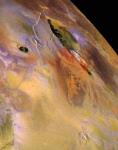 Zal Patera on Jupiter's Moon Io
7.03.2000
The Galileo orbiter's flyby of Io last November captured an unusual part of Jupiter's volcanic moon. From 26,000 kilometers away, Zal Patera was found to be a cauldron of flowing lava, gaseous vents, and tremendous peaks.
|
January February March April May June July August September October |
|||||||||||||||||||||||||||||||||||||||||||||||||