
|
You entered: NASA
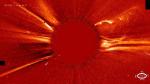 Red Sun Streaming
7.01.1997
The Sun is leaking. In fact, it is gushing: particles stream away from the Sun at hundreds of kilometers per second. Some of these particles strike the Earth and cause aurora. Most particles, however, either surround the Sun as a huge solar corona or glide into interstellar space as the solar wind.
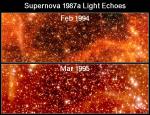 Moving Echoes Around SN 1987A
24.10.1997
Yesterday's image highlighted reflective rings of light emitted by a supernova explosion. Today's pictures, taken over a year apart, highlight how these echoes are seen to move over time. Visible...
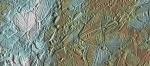 Europa's Disconnected Surface
2.01.1998
Jupiter's moon Europa is so exciting that the Galileo spacecraft orbiting Jupiter has now embarked on an extended mission to study it. Oceans that might exist beneath Europa's surface are thought to be one of the best places to look for life in our Solar System.
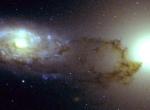 Dusting Spiral Galaxies
16.01.1998
How much dust is in spiral galaxies? Does it block out much of the starlight? Because astronomers rely on an accurate knowledge of galaxy properties to investigate a wide range of problems, like galaxy and quasar evolution and the nature of dark matter, answers to simple questions like this are key.
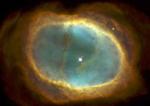 NGC 3132: The Eight Burst Nebula
10.11.1998
It's the dim star, not the bright one, near the center of NGC 3132 that created this odd but beautiful planetary nebula. Nicknamed the Eight-Burst Nebula and the Southern Ring Nebula, the glowing gas originated in the outer layers of a star like our Sun.
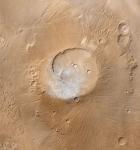 Mars Volcano Apollinaris Patera
13.05.1999
Dwarfed by Olympus Mons and the other immense shield volcanos on Mars, Apollinaris Patera rises only 3 miles or so into the thin martian atmosphere, but bright water-ice clouds can be still be seen hovering around its summit.
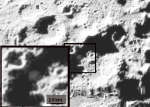 Water Discovered in Moon Shadow
18.11.2009
Why is there water on the Moon? Last month, the LCROSS mission crashed a large impactor into a permanently shadowed crater near the Moon's South Pole. A plume of dust rose that was visible to the satellite, although hard to discern from Earth. The plume is shown above in visible light.
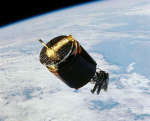 The Astronaut Who Captured a Satellite
11.01.2010
In 1984, high above the Earth's surface, an astronaut captured a satellite. It was the second satellite captured that mission. Pictured above, astronaut Dale A. Gardner flies free using the Manned Maneuvering Unit and begins to attach a control device dubbed the Stinger to the rotating Westar 6 satellite.
 X Class Flare
17.02.2011
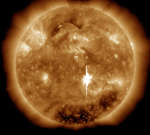
On Valentine's Day (ET) the Sun unleased one of its most powerful explosions, an X-class flare. The blast was the largest so far in the new solar cycle. Erupting from active region AR1158...
 The International Space Station Expands Again
9.03.2011
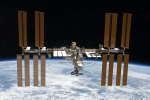
The developing International Space Station (ISS) has changed its appearance again. In a recently completed rendezvous, the Space Shuttle orbiter Discovery, in its final flight, visited the ISS and added components that included the Leonardo Multi Purpose Logistics Module.
|
January February March April May June July August September October |
|||||||||||||||||||||||||||||||||||||||||||||||||