
|
You entered: NASA
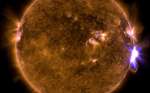 Flare Well AR2673
14.09.2017
Almost out of view from our fair planet, rotating around the Sun's western edge giant active region AR2673 lashed out with another intense solar flare followed by a large coronal mass ejection on September 10.
 M100: A Grand Design Spiral Galaxy
25.12.2018
Majestic on a truly cosmic scale, M100 is appropriately known as a grand design spiral galaxy. It is a large galaxy of over 100 billion stars with well-defined spiral arms that is similar to our own Milky Way Galaxy.
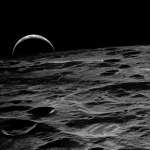 Apollo 14 Heads for Home
1.02.2020
When leaving lunar orbit in February 1971, the crew of Apollo 14 watched this Earthrise from their command module Kittyhawk. With Earth's sunlit crescent just peaking over the lunar horizon, the cratered terrain in the foreground is along the lunar farside.
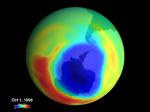 The Worlds Largest Ozone Hole
14.10.1998
It's back, and it's bigger than ever. The ozone hole that has been a cause of concern in recent years has again reformed over Earth's South Pole. The seasonal recurrence of the ozone hole was expected, although the size of the hole has never been so large this early in the season.
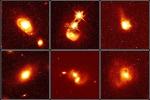 A Quasar Portrait Gallery
6.12.1997
QUASARs (QUASi-stellAR objects) lie near the edge of the observable Universe. Discovered in 1963, astronomers were astounded that such objects could be visible across billions of light-years, as this implies they must emit prodigious amounts of energy. Where does the energy come from?
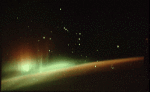 Aurora and Orion
14.11.1995
Looking toward the south from low Earth orbit, the crew of the Space Shuttle Endeavor made this stunning time exposure of the Aurora Australis (southern lights) in April of 1994. The aurora are caused by high energy electrons from the Solar Wind which are funneled into the atmosphere by the Earth's magnetic field.
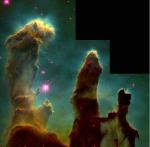 From Eagle's EGGs A Star Is Born
19.01.1997
Perhaps the most famous astronomical image in recent years reveals newborn stars upon pillars of gas and dust - uncovered as researchers used the Hubble Space Telescope to explore the Eagle Nebula in 1995. This...
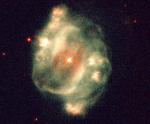 NGC 5307: A Symmetric Planetary Nebula
31.12.1997
Some stellar nebulae are strangely symmetric. For example, every major blob of gas visible on the upper left of NGC 5307 appears to have a counterpart on the lower right. This picture taken by the Hubble Space Telescope was released last week. NGC 5307 is an example of a planetary nebula with a spiral shape.
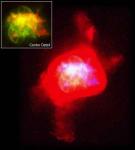 NGC 6210: The Turtle in Space Planetary Nebula
28.10.1998
A Turtle in Space? Planetary nebula NGC 6210 may look like a giant space turtle, but it is actually much more massive and violent. Fortunately, this gas cloud in Hercules lies about 6500 light years away.
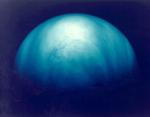 Venus: Just Passing By
25.06.2005
Venus, the second closest planet to the Sun, is by far the brightest of the three planets gathered in this weekend's western sky at sunset. It has also proven to be a popular way-point for spacecraft headed for the gas giant planets in the outer reaches of the solar system. Why visit Venus first?
|
January February March April May June July August September October |
|||||||||||||||||||||||||||||||||||||||||||||||||