
|
You entered: NASA
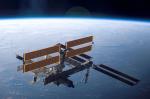 The International Space Station Expands Again
20.09.2006
The developing International Space Station (ISS) has changed its appearance again. Over the past few days, the Space Shuttle Atlantis visited the ISS and pieces of the Integrated Truss Structure, including an impressively long array of solar panels.
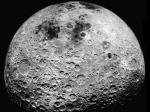 The Far Side of the Moon
24.02.2007
Does this moon look familiar? Possibly not, even though it is Earth's Moon. Locked in synchronous rotation, the Moon always presents its well-known near side to Earth. But from lunar orbit, Apollo astronauts also grew to know the Moon's far side.
 The Cats Eye Nebula
26.08.2012
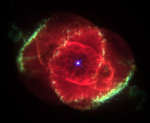
Three thousand light-years away, a dying star throws off shells of glowing gas. This image from the Hubble Space Telescope reveals the Cat's Eye Nebula to be one of the most complex planetary nebulae known.
 The Cats Eye Nebula
2.07.2016
Three thousand light-years away, a dying star throws off shells of glowing gas. This image from the Hubble Space Telescope reveals the Cat's Eye Nebula to be one of the most complex planetary nebulae known.
 Daphnis and the Rings of Saturn
21.02.2017
What's happening to the rings of Saturn? Nothing much, just a little moon making waves. The moon is 8-kilometer Daphnis and it is making waves in the Keeler Gap of Saturn's rings using just its gravity -- as it bobs up and down, in and out.
 Falcon Heavy Boostback Burn
19.01.2024
The December 28 night launch of a Falcon Heavy rocket from Kennedy Space Center in Florida marked the fifth launch for the rocket's reusable side boosters. About 2 minutes 20 seconds into the flight, the two side boosters separated from the rocket's core stage.
 A Close-Up of the Lagoon's Hourglass
21.08.1996
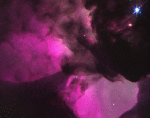
In the central part of the Lagoon Nebula lies the above pictured Hourglass Nebula. In this region of recent star formation, obscuring dark lanes of dust permeate the red-glowing hydrogen gas. Blocking some...
 Smog Over New York
7.05.2002
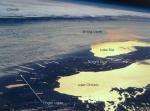
What is not pretty about the above picture? In a word: smog. In 2000 October the orbiting Space Shuttle Discovery photographed update New York just at sunset. Visible is golden sunlight reflecting from two of the Great Lakes (Erie and Ontario), and several of the Finger Lakes.
 Comet Hale-Bopp Update
29.10.1995
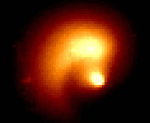
Will comet Hale-Bopp become the brightest comet of the Century in early 1997? Since its discovery in July this year, Hale-Bopp has caused much speculation. Even though it is still beyond the orbit of Jupiter it is astonishingly bright and expected to get much brighter as it plunges inward, toward the Sun.
 M101: An Ultraviolet View
8.06.1997
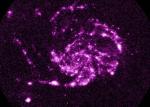
This giant spiral galaxy, Messier 101 (M101), was photographed by the Ultraviolet Imaging Telescope (UIT). UIT flew into orbit as part of the Astro 2 mission on-board the Space Shuttle Endeavour in March 1995. The image has been processed so that the colors (purple to white) represent an increasing intensity of ultraviolet light.
|
January February March April May June July August September October |
|||||||||||||||||||||||||||||||||||||||||||||||||