
|
You entered: NASA
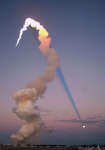 Shuttle Plume Shadow Points to the Moon
27.11.2011
Why would the shadow of a space shuttle launch plume point toward the Moon? In early 2001 during a launch of Atlantis, the Sun, Earth, Moon, and rocket were all properly aligned for this photogenic coincidence.
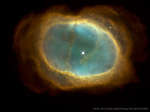 NGC 3132: The Eight Burst Nebula
7.06.2015
It's the dim star, not the bright one, near the center of NGC 3132 that created this odd but beautiful planetary nebula. Nicknamed the Eight-Burst Nebula and the Southern Ring Nebula, the glowing gas originated in the outer layers of a star like our Sun.
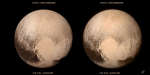 Stereo Pluto
6.08.2015
These two detailed, true color images of Pluto were captured during the historic New Horizons flyby last month. With slightly different perspectives on the now recognizeable surface features they are presented in this first high quality stereo pair intended for viewing by denizens of planet Earth.
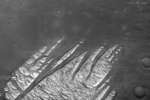 White Rock Fingers on Mars
15.02.2016
What caused this unusual light rock formation on Mars? Intrigued by the possibility that they could be salt deposits left over as an ancient lakebed dried-up, detailed studies of these fingers now indicate a more mundane possibility: volcanic ash. Studying the exact color of the formation indicated the possible volcanic origin.
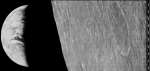 Lunar Orbiter Earthset
27.08.2016
August 10th was the 50th anniversary of the launch of Lunar Orbiter 1. It was the first of five Lunar Orbiters intended to photograph the Moon's surface to aid in the selection of future landing sites.
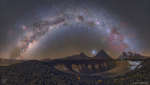 Milky Way over Chilean Volcanoes
21.08.2017
Sometimes, the sky mimics the ground. Taken in 2017 May from the Atacama Desert in Chile, the foreground of the featured image encompasses the dipping edge of the caldera of an extinct volcano. Poetically echoing the dip below is the arch of our Milky Way Galaxy above.
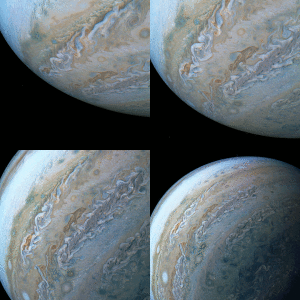 Swimming on Jupiter
14.12.2018
On October 29, the Juno spacecraft once again dove near the turbulent Jovian cloud tops. Its 16th orbital closest approach or perijove passage, brought Juno within 3,500 kilometers of the Solar System's largest planetary atmosphere.
 Messier 2
4.04.2019
After the Crab Nebula, M1, this giant star cluster is the second entry in 18th century astronomer Charles Messier's famous list of things with are not comets. M2 is one of the largest globular star clusters now known to roam the halo of our Milky Way galaxy.
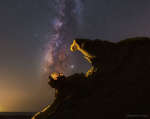 Jupiter Engulfed and the Milky Way
7.08.2019
This is a good month to see Jupiter. To find our Solar System's largest planet in your sky, look toward the southeast just after sunset -- Jupiter should be the brightest object in that part of the sky.
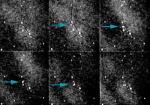 Interplanetary Spaceship Passes Earth
26.01.1998
Last Thursday an interplanetary spacecraft flew right past the Earth. The above images show sunlight momentarily reflected from this spacecraft's solar panels. No aliens were involved - the Near Earth Asteroid Rendezvous (NEAR) mission actually originated from Earth. Launched in 1996, NEAR zipped past the asteroid 253 Mathilde last June.
|
January February March April May June July August September October |
|||||||||||||||||||||||||||||||||||||||||||||||||