
|
You entered: NASA
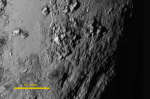 50 Miles on Pluto
16.07.2015
A 50 mile (80 kilometer) trip across Pluto would cover the distance indicated by the scale bar in this startling image. The close-up of the icy world's rugged equatorial terrain was captured when the New Horizons spacecraft was about 47,800 miles (77,000 kilometers) from the surface, 1.5 hours before its closest approach.
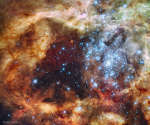 Star Cluster R136 Bursts Out
24.01.2016
In the center of star-forming region 30 Doradus lies a huge cluster containing some of the largest, hottest, and most massive stars known. These stars, known collectively as star cluster R136, were captured in the featured image in visible light by the Wide Field Camera 3 in 2009 peering through the Hubble Space Telescope.
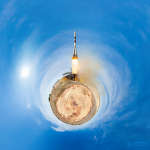 Little Planet Soyuz
15.06.2018
Engines blazing, a large rocket bids farewell to this little planet. Of course, the little planet is really planet Earth and the large rocket is a Soyuz-FG rocket. Launched from the Baikonur Cosmodrome in Kazakhstan on June 6 it carried a Soyuz MS-09 spacecraft into orbit.
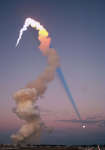 Rocket Plume Shadow Points to the Moon
24.06.2018
Why would the shadow of a space shuttle launch plume point toward the Moon? In early 2001 during a launch of Atlantis, the Sun, Earth, Moon, and rocket were all properly aligned for this photogenic coincidence.
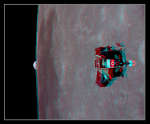 The Eagle Rises
13.07.2019
Get out your red/blue glasses and check out this stereo view from lunar orbit. The 3D anaglyph was created from two photographs (AS11-44-6633, AS11-44-6634) taken by astronaut Michael Collins during the 1969 Apollo 11 mission.
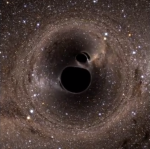 When Black Holes Collide
11.04.2021
What happens when two black holes collide? This extreme scenario occurs in the centers of many merging galaxies and multiple star systems. The featured video shows a computer animation of the final stages of such a merger, while highlighting the gravitational lensing effects that would appear on a background starfield.
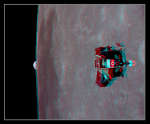 The Eagle Rises
30.07.2022
Get out your red/blue glasses and check out this stereo view from lunar orbit. The 3D anaglyph was created from two photographs (AS11-44-6633, AS11-44-6634) taken by astronaut Michael Collins during the 1969 Apollo 11 mission.
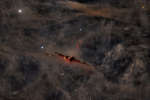 APOD: 2026 July 9 Б The Red Glow of the Cosmic Bat Nebula
9.07.2026
This Cosmic Bat wishes you a happy Summerween! This mid-year celebration of Halloween transcends hemispheres, even though summer in the Northern hemisphere is winter in the South. Contrary to its eery aura, the Cosmic Bat Nebula (LDN 43), not to be confused with the Bat Nebula (NGC 6995), is a vibrant birthplace for stars.
 Trapezium: Teardrops in My Skies
16.01.1997
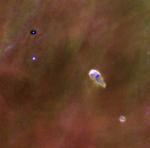
Sometimes the unexpected comes in a familiar shape. In this recently released picture, the seemingly familiar teardrop-shaped object just right of center is actually an unusually situated disk of gas and dust. In fact, the teardrop is about the size of our own Solar System and is racing against time to condense and form planets.
 Venus: Earth's Sister Planet
15.08.1995
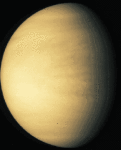
This picture in visible light was taken by the Galileo spacecraft. Venus is very similar to Earth in size and mass - and so is sometimes referred to as Earth's sister planet - but Venus has a quite different climate.
|
January February March April May June July August September October |
|||||||||||||||||||||||||||||||||||||||||||||||||