
|
You entered: NASA
 APOD: 2023 April 8 Б M100: A Grand Design Spiral Galaxy
8.04.2023
Majestic on a truly cosmic scale, M100 is appropriately known as a grand design spiral galaxy. It is a large galaxy of over 100 billion stars with well-defined spiral arms that is similar to our own Milky Way Galaxy.
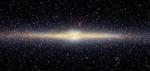 The Milky Way in Infrared
29.12.1997
At night, from a dark location, part of the clear sky looks milky. This unusual swath of dim light is generally visible during any month and from any location. Until the invention of the telescope, nobody really knew what the "Milky Way" was.
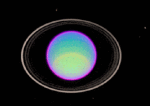 Uranus' Ring System
30.04.1996
The rings of Uranus are thin, narrow, and dark compared to other planetary ring systems. Brightened artificially by computer, the ring particles reflect as little light as charcoal, although they are really made of ice chucks darkened by rock.
 In the Center of the Whirlpool
25.04.1996
In the center of M51, a spiral galaxy 23 million light-years away, astronomers have identified a dense region of young stars. The graceful swirling arcs of this galaxy's spiral arms have inspired its popular name, "The Whirlpool Galaxy".
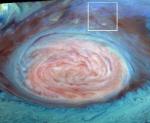 Storm Clouds Over Jupiter
27.11.1996
Storm clouds, similar to the familiar cumulonimbus thunderheads of Earth, appear to be present on Jupiter. The mosaic of images above shows the region near the raging edge of Jupiter's Great Red Spot, itself some 2 to 3 Earths wide, as observed by the Galileo spacecraft in June of this year.
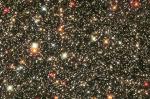 Sagittarius Star Cloud
13.01.1999
Stars come in all different colors. The color of a star indicates its surface temperature, an important property used to assign each star a spectral type. Most stars in the above Sagittarius Star Cloud are orange or red and relatively faint, as our Sun would appear.
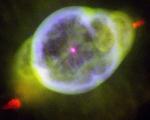 NGC 3242: The Ghost of Jupiter
29.10.2005
After a star like the Sun completes fusion in its core, it throws off its outer layers in a brief, beautiful cosmic display called a planetary nebula. NGC 3242 is such a planetary nebula, with the stellar remnant white dwarf star visible at the center.
 R136: The Massive Stars of 30 Doradus
11.12.2005
In the center of star-forming region 30 Doradus lies a huge cluster of the largest, hottest, most massive stars known. These stars, known as the star cluster R136, and part of the surrounding nebula are captured here in this gorgeous visible-light image from the Hubble Space Telescope.
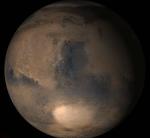 Northern Spring on Mars
25.03.2006
Astronomical spring came to planet Earth's northern hemisphere this week (and autumn to the south) with the equinox on March 20th. But on Mars, northern spring began on January 22nd. Still in northern...
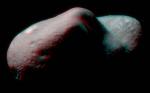 Stereo Eros
24.02.2000
Get out your red/blue glasses and float next to asteroid 433 Eros, 260 million kilometers away! Orbiting the Sun once every 1.8 earth-years, asteroid Eros is a diminutive 40 x 14 x 14 kilometer world of undulating horizons, craters, boulders and valleys.
|
January February March April May June July August September October |
|||||||||||||||||||||||||||||||||||||||||||||||||