
|
You entered: NASA
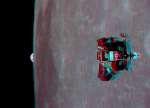 The Eagle Rises
10.08.2008
Get out your red/blue glasses and check out this remarkable stereo view from lunar orbit. Created from two photographs (AS11-44-6633, AS11-44-6634) taken by astronaut Michael Collins during the 1969 Apollo 11 mission, the 3D anaglyph features the lunar module ascent stage, dubbed The Eagle, as it rises to meet the command module in lunar orbit.
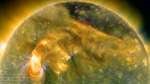 The Not So Quiet Sun
6.08.2010
After a long solar minimum, the Sun is no longer so quiet. On August 1, this extreme ultraviolet snapshot of the Sun from the Solar Dynanimcs Observatory captured a complex burst of activity playing across the Sun's northern hemisphere.
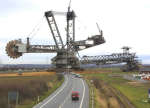 A Bucket Wheel Excavator on Earth
24.10.2010
Please wait while one of the largest mobile machines in the world crosses the road. The machine pictured above is a bucket-wheel excavator used in modern surface mining. Machines like this have given humanity the ability to mine minerals and change the face of planet Earth in new and dramatic ways.
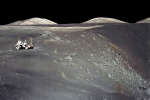 Apollo 17 at Shorty Crater
24.06.2012
In December of 1972, Apollo 17 astronauts Eugene Cernan and Harrison Schmitt spent about 75 hours on the Moon in the Taurus-Littrow valley, while colleague Ronald Evans orbited overhead. This sharp image was taken by Cernan as he and Schmitt roamed the valley floor.
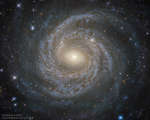 NGC 6814: Grand Design Spiral Galaxy from Hubble
21.06.2016
In the center of this serene stellar swirl is likely a harrowing black-hole beast. The surrounding swirl sweeps around billions of stars which are highlighted by the brightest and bluest. The breadth and beauty of the display give the swirl the designation of a grand design spiral galaxy.
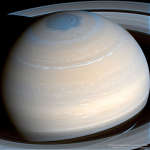 Saturn in Infrared from Cassini
3.04.2017
Many details of Saturn appear clearly in infrared light. Bands of clouds show great structure, including long stretching storms. Also quite striking in infrared is the unusual hexagonal cloud pattern surrounding Saturn's North Pole. Each side of the dark hexagon spans roughly the width of our Earth.
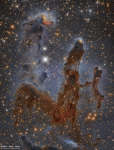 Pillars of the Eagle Nebula in Infrared
7.03.2021
Newborn stars are forming in the Eagle Nebula. Gravitationally contracting in pillars of dense gas and dust, the intense radiation of these newly-formed bright stars is causing surrounding material to boil away. This image...
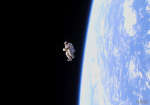 SuitSat 1: A Spacesuit Floats Free
28.03.2021
A spacesuit floated away from the International Space Station 15 years ago, but no investigation was conducted. Everyone knew that it was pushed by the space station crew. Dubbed Suitsat-1, the unneeded Russian Orlan spacesuit filled mostly with old clothes was fitted with a faint radio transmitter and released to orbit the Earth.
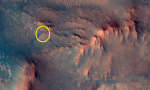 APOD: 2026 June 27 Б Mars Marathon by Perseverance
27.06.2026
In this recent HiRISE view from the Mars Reconnaissance Orbiter, the little green dot indicated on the surface of the big Red Planet is the Perseverance Mars rover. Recorded on June 13, the car-sized...
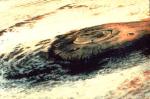 Olympus Mons on Mars: The Largest Volcano
15.09.1997
The largest volcano in the Solar System is on Mars. Olympus Mons rises 24 kilometers high and measures 550 km across. By comparison, Earth's largest volcano, Mauna Loa in Hawaii, rises 9 km high and measures 120 km across.
|
January February March April May June July August September October |
|||||||||||||||||||||||||||||||||||||||||||||||||