
|
You entered: NASA
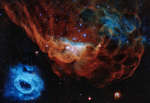 Hubble s Cosmic Reef
25.04.2020
These bright ridges of interstellar gas and dust are bathed in energetic starlight. With its sea of young stars, the massive star-forming region NGC 2014 has been dubbed the Cosmic Reef. Drifting just...
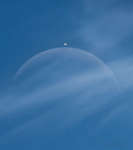 APOD: 2026 September 15 Б A Daytime Eclipse: Moon Occults Venus
15.09.2026
There was something behind the clouds. Upon close inspection, it was the Moon, which was hard to see yesterday around noon above the small village of Cessy, France. But soon, it was not only the Moon. As expected, a bright dot suddenly appeared from behind the Moon -- the planet Venus far in the distance.
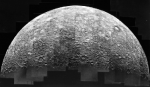 Mercury: A Cratered Inferno
12.09.1996
Mercury's surface looks similar to our Moon's. Each is heavily cratered and made of rock. Mercury's diameter is about 4800 km, while the Moon's is slightly less at about 3500 km (compared with about 12,700 km for the Earth). But Mercury is unique in many ways.
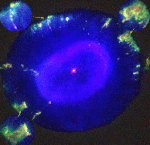 Fliers Around the Blue Snowball Nebula
22.11.1996
Planetary nebulae are strange. First, they are gas clouds and have nothing to do with our Solar System's planets. Next, although hundreds of planetary nebulae have been catalogued and thousands surely exist in our Galaxy, aspects of the formation process are still debated.
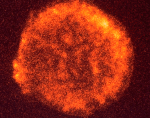 Tychos Supernova Remnant in X ray
7.03.1999
How often do stars explode? By looking at external galaxies, astronomers can guess that these events, known as a supernovae, should occur about once every 30 years in a typical spiral galaxy like our MilkyWay.
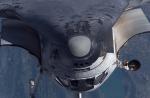 A Shuttle Back Flip at the Space Station
2.08.2005
Last week, crew members of the International Space Station (ISS) watched carefully as the Space Shuttle Discovery did a planned but unusual back flip upon approach. Discovery Commander Eileen Collins guided the shuttle through the flip, which was about 200 meters from the ISS when the above picture was taken.
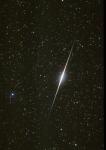 Iridium 52: Not A Meteor
22.10.1999
While hunting for meteors in the night sky above the White Mountains near Bishop, California, astrophotographer James Young instead captured this brilliant celestial apparition. Recorded near twilight on August 13, the bright streak is not the flash of a meteor trail but sunlight glinting from a satellite.
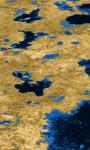 Liquid Lakes on Saturns Titan
7.02.2007
Why would some regions on Titan reflect very little radar? The leading explanation is that these regions are lakes, possibly composed of liquid methane. The above image is a false-color synthetic radar map of a northern region of Titan taken during a flyby of the cloudy moon by the robotic Cassini spacecraft last July.
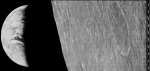 Restored: First Image of the Earth from the Moon
18.11.2008
Pictured above is the first image ever taken of the Earth from the Moon. The image was taken in 1966 by Lunar Orbiter 1 and heralded by then-journalists as the Image of the Century. It was taken about two years before the Apollo 8 crew snapped its more famous color cousin.
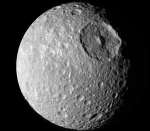 Mimas: Small Moon with a Big Crater
17.05.2009
Whatever hit Mimas nearly destroyed it. What remains is one of the largest impact craters on one of Saturn's smallest moons. The crater, named Herschel after the 1789 discoverer of Mimas, Sir William Herschel, spans about 130 kilometers and is pictured above.
|
January February March April May June July August September October |
|||||||||||||||||||||||||||||||||||||||||||||||||