
|
You entered: NASA
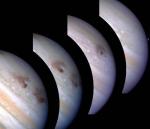 Jupiter Swallows Comet Shoemaker Levy 9
4.08.1998
What happens when a comet encounters a planet? If the planet has a rocky surface, a huge impact feature will form. A giant planet like Jupiter, however, is mostly gas. When Comet Shoemaker-Levy 9 struck Jupiter in 1994, each piece was swallowed into the vast Jovian atmosphere.
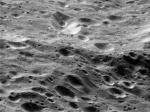 620 Kilometers Above Rhea
13.12.2005
What does the surface of Saturn's moon Rhea look like? To help find out, the robot Cassini spacecraft currently orbiting Saturn was directed to fly right past the second largest moon of the gas giant planet late last month.
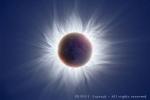 The Big Corona
15.09.1999
Most photographs don't adequately portray the magnificence of the Sun's corona. Seeing the corona first-hand during a total solar eclipse is best. The human eye can adapt to see features and extent that photographic film usually cannot. Welcome, however, to the digital age.
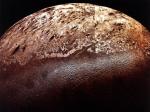 Triton: Neptunes Largest Moon
4.03.2007
In October of 1846, William Lassell was observing the newly discovered planet Neptune. He was attempting to confirm his observation, made just the previous week, that Neptune had a ring. But this time he discovered that Neptune had a satellite as well.
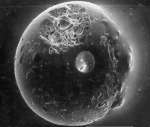 A Spherule from the Earths Moon
10.01.2010
How did this spherule come to be on the Moon? When a meteorite strikes the Moon, the energy of the impact melts some of the splattering rock, a fraction of which might cool into tiny glass beads. Many of these glass beads were present in lunar soil samples returned to Earth by the Apollo missions.
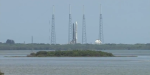 Juno Rockets Toward Jupiter
9.08.2011
Next stop: Jupiter. Last week included one of the few times in history that humanity launched something completely off the Earth, moving away so fast that it will never return. Well, almost -- Juno...
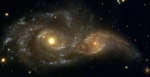 Spiral Galaxies in Collision
19.01.2014
Billions of years from now, only one of these two galaxies will remain. Until then, spiral galaxies NGC 2207 and IC 2163 will slowly pull each other apart, creating tides of matter, sheets of shocked gas, lanes of dark dust, bursts of star formation, and streams of cast-away stars.
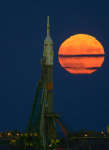 Soyuz vs Supermoon
17.11.2016
Faster than a speeding bullet, more powerful than a locomotive, and able to leap tall buildings in a single bound, this Soyuz rocket stands on the launch pad at Baikonur Cosmodrome in Kazakhstan on November 14.
 Dusty With a Chance of Dust
16.06.2018
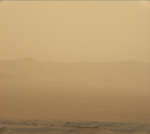
It's storm season on Mars. Dusty with a chance of dust is the weather report for Gale crater as a recent planet-scale dust storm rages. On June 10 looking toward the east-northeast crater rim, the Curiosity rover's Mastcam captured this image of its local conditions so far.
 Crescent Enceladus
9.03.2019
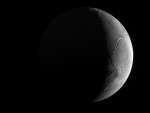
Peering from the shadows, the Saturn-facing hemisphere of tantalizing inner moon Enceladus poses in this Cassini spacecraft image. North is up in the dramatic scene captured during November 2016 as Cassini's camera was pointed in a nearly sunward direction about 130,000 kilometers from the moon's bright crescent.
|
January February March April May June July August September October |
|||||||||||||||||||||||||||||||||||||||||||||||||