
|
You entered: NASA
 Reflections on Planet Earth
2.01.2014
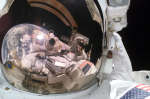
Catching sight of your reflection in a store window or shiny hubcap can be entertaining and occasionally even inspire a thoughtful moment. So consider this reflective view from 300 kilometers above planet Earth.
 1000 Sols
13.06.2015
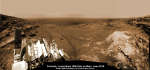
Shortly before Mars' June 2015 conjunction, the Curiosity Rover celebrated 1000 sols on the red planet. After its August 5, 2012 landing, Curiosity's 1000th sol or martian day on the surface corresponded to planet Earth's calendar date May 31, 2015.
 Where to See the American Eclipse
31.01.2017
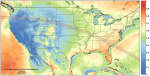
Are you planning to see the American Eclipse on August 21? A few hours after sunrise, a rare total eclipse of the Sun will be visible along a narrow path across the USA. Those only near the path will see a partial eclipse.
 Crescent Enceladus
9.02.2017
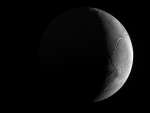
Peering from the shadows, the Saturn-facing hemisphere of tantalizing inner moon Enceladus poses in this Cassini spacecraft image. North is up in the dramatic scene captured last November as Cassini's camera was pointed in a nearly sunward direction about 130,000 kilometers from the moon's bright crescent.
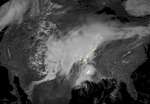 Lightning Storm Moves Across the USA
15.05.2017
Watch a huge lightning storm move across the eastern USA. The huge storm caused much damage and unfortunately some loss of life for people in its path. Seen from space, the lightning is seen as momentary flashes in the featured time-lapse video recorded last month by the Geostationary Lightning Mapper (GLM) aboard the GOES-16 satellite.
 The Veins of Heaven
26.07.2019
Transfusing sunlight through a still dark sky, this exceptional display of noctilucent clouds was captured earlier this month, reflected in the calm waters of Vallentuna Lake near Stockholm, Sweden. From the edge of space...
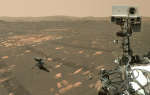 Perseverance Selfie with Ingenuity
1.07.2021
On sol 46 (April 6, 2021) the Perseverance rover held out a robotic arm to take its first selfie on Mars. The WATSON camera at the end of the arm was designed to take close-ups of martian rocks and surface details though, and not a quick snap shot of friends and smiling faces.
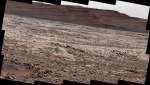 The Gator Back Rocks of Mars
15.04.2022
Wind-sharpened rocks known as ventifacts, cover this broad sloping plain in the foot hills of Mount Sharp, Gale crater, Mars. Dubbed gator-back rocks their rugged, scaly appearance is captured in these digitally stitched Mastcam frames from the Curiosity rover on mission sol 3,415 (March 15, 2022).
 A Harvest Moon over Tuscany
30.09.2023
For northern hemisphere dwellers, September's Full Moon was the Harvest Moon. Reflecting warm hues at sunset, it rises behind cypress trees huddled on a hill top in Tuscany, Italy in this telephoto view from September 28.
 APOD: 2024 January 2 Б Rocket Transits Rippling Moon
2.01.2024
Can a rocket make the Moon ripple? No, but it can make a background moon appear wavy. The rocket, in this case, was a SpaceX Falcon Heavy that blasted off from NASA's Kennedy Space Center last week.
|
January February March April May June July August September October |
|||||||||||||||||||||||||||||||||||||||||||||||||