
|
You entered: NASA
 Five Meters over Mars
10.08.2023
On mission sol 872 (Earth date August 3) Ingenuity snapped this sharp image on its 54th flight above the surface of the Red Planet. During the flight the Mars Helicopter hovered about 5 meters, or just over 16 feet, above the Jezero crater floor.
 Messier 87
20.02.2025
Enormous elliptical galaxy Messier 87 is about 50 million light-years away. Also known as NGC 4486, the giant galaxy holds trillions of stars compared to the mere billions of stars in our large spiral Milky Way. M87 reigns as the large central elliptical galaxy in the Virgo galaxy cluster.
 Lunar Dust and Duct Tape
28.03.2025
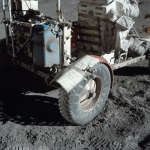
Why is the Moon so dusty? On Earth, rocks are weathered by wind and water, creating soil and sand. On the Moon, eons of constant micrometeorite bombardment have blasted away at the rocky surface creating a layer of powdery lunar soil or regolith.
 APOD: 2026 June 16 Б Moons, Rings, Shadows, Clouds: Saturn Cassini
16.06.2026
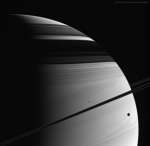
While cruising around Saturn, be on the lookout for picturesque arrangements of moons, rings, and shadows. One such striking sight occurred in 2005 and was captured by the then Saturn-orbiting Cassini spacecraft.
 Triton: Neptune's Largest Moon
10.10.1996
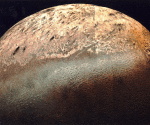
Today marks the 150th anniversary of the discovery of Triton. On October 10 1846, William Lassell was observing the newly discovered planet Neptune. He was attempting to confirm his observation, made just the previous week, that Neptune had a ring. But this time he discovered that Neptune had a satellite as well.
 Mercury: A Cratered Inferno
30.11.1997
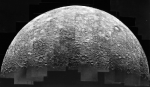
Mercury's surface looks similar to our Moon's. Each is heavily cratered and made of rock. Mercury's diameter is about 4800 km, while the Moon's is slightly less at about 3500 km (compared with about 12,700 km for the Earth). But Mercury is unique in many ways.
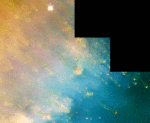 At the Edge of the Helix
22.04.1996
While exploring the inner edge of the Helix Nebula with the Hubble Space Telescope's Wide Field Planetary Camera 2, astronomers were able to produce this striking image - rich in details of an exotic environment.
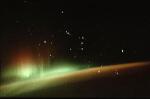 Aurora and Orion
26.01.1997
Looking toward the south from low Earth orbit, the crew of the Space Shuttle Endeavor made this stunning time exposure of the Aurora Australis or southern lights in April of 1994. Aurora are visible at high northern latitudes as well, with the northern lights known as Aurora Borealis.
 NGC 3242: The 'Ghost of Jupiter' Planetary Nebula
31.03.1997
It's a weed, it's Jupiter, no it's - actually planetary nebula NGC 3242. After a star like our Sun completes fusion in its core, it throws off its outer layers it a striking display called a planetary nebula.
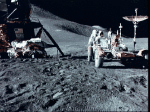 Apollo 15: Driving on the Moon
7.06.1997
Apollo 15 astronaut James Irwin works on the first Lunar Roving Vehicle, before he and fellow astronaut David Scott take it out for a drive. Sloping up behind the lunar module "Falcon" on the left are lunar mountains Hadley Delta and Apennine Front, while about 5 kilometers behind Irwin is St. George Crater.
|
January February March April May June July August September October |
|||||||||||||||||||||||||||||||||||||||||||||||||