
|
You entered: NASA
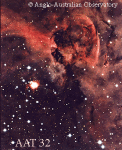 The Keyhole Nebula Near Eta Carinae
4.04.1996
The dark dusty Keyhole Nebula gets its name from its unusual shape. Designated NGC 3324, the Keyhole Nebula is a smaller region superposed on the bright Eta Carina Nebula. The Eta Carina Nebula...
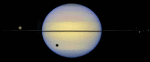 Saturn's Rings Seen Sideways
29.04.1996
Saturn's rings are actually very thin. This picture from the Hubble Space Telescope was taken on August 6, 1995 when the rings lined up sideways as seen from Earth. Saturn's largest moon Titan is seen on the left, and Titan's shadow can be seen on Saturn's cloud tops!
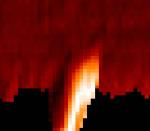 Tornadoes on the Sun
29.04.1998
Giant spinning clouds of gas, similar to Earth's tornadoes, have been found on the Sun. Solar tornadoes, however, can be larger than the entire Earth, and sustain wind gusts over 1000 times stronger than their Earth counterparts.
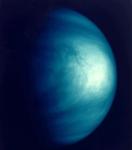 Venus: Just Passing By
1.05.1998
Venus, the second closest planet to the Sun, is a popular way-point for spacecraft headed for the gas giant planets in the outer reaches of the solar system. Why visit Venus first? Using...
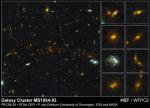 Cosmic Collisions in a Galaxy Cluster
22.07.1999
Hundreds of galaxies appear as faint smudges of light in this Hubble Space Telescope picture of galaxy cluster MS1054-03. Eight billion light-years away, the cluster is among the most distant known clusters of galaxies and is now reported to contain the largest number of colliding galaxies ever found in a cluster.
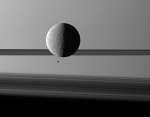 Moons and Rings Before Saturn
31.05.2010
While cruising around Saturn, be on the lookout for picturesque juxtapositions of moons and rings. Another striking alignment occurred last March in the view of humanity's Saturn-orbiting Cassini spacecraft. Rhea, one of Saturn's larger moons, was caught passing Epimetheus, one of Saturn's smaller moons.
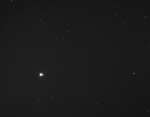 Earth and Moon from MESSENGER
1.09.2010
What does Earth look like from the planet Mercury? The robotic spacecraft MESSENGER found out as it looked toward the Earth during its closest approach to the Sun about three months ago. The Earth and Moon are visible as the double spot on the lower left of the above image.
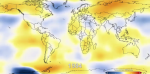 130 Years of Earth Surface Temperatures
31.07.2013
How has the surface temperature of Earth been changing? To help find out, Earth scientists collected temperature records from over 1000 weather stations around the globe since 1880, and combined them with modern satellite data.
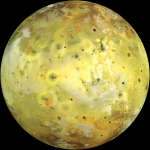 Io in True Color
30.03.2014
The strangest moon in the Solar System is bright yellow. This picture, an attempt to show how Io would appear in the "true colors" perceptible to the average human eye, was taken in 1999 July by the Galileo spacecraft that orbited Jupiter from 1995 to 2003.
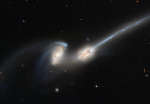 NGC 4676: When Mice Collide
31.01.2015
These two mighty galaxies are pulling each other apart. Known as the "Mice" because they have such long tails, each spiral galaxy has likely already passed through the other. The long tails are created by the relative difference between gravitational pulls on the near and far parts of each galaxy.
|
January February March April May June July August September October |
|||||||||||||||||||||||||||||||||||||||||||||||||