
|
You entered: NASA
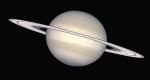 Natural Saturn On The Cassini Cruise
5.11.1998
What you could see approaching Saturn aboard an interplanetary cruise ship would closely resemble this subtly shaded view of the gorgeous ringed gas giant. Processed by the Hubble Heritage project, the picture intentionally avoids...
 Releasing Compton
29.11.1995
Named for Nobel laureate physicist Arthur Holly Compton, the Compton Gamma Ray Observatory (CGRO) Satellite was launched in April of 1991 aboard the Space Shuttle Atlantis. CGRO's mission is to explore the Universe at gamma-ray energies.
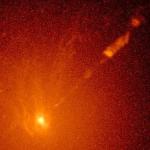 A Black Hole in M87?
5.04.1997
The center of nearby giant galaxy M87 is a dense and violent place. In this 1994 photograph by the Hubble Space Telescope, a disk of hot gas was found to be orbiting at the center of this massive elliptical galaxy. The disk is evident at the lower left of the picture.
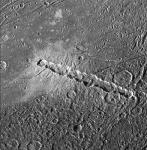 Ganymede: Torn Comet Crater Chain
5.08.1998
This remarkable line of 13 closely spaced craters on Jupiter's moon Ganymede was photographed by the Galileo spacecraft in 1997. The picture covers an area about 120 miles wide and the chain of craters cuts across a sharp boundary between dark and light terrain. What caused this crater chain?
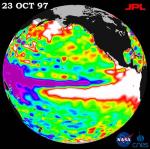 El Nino Earth
12.11.1997
El Niño is a temporary global climate change resulting from unusually warm water in the central Pacific Ocean. El Niño can cause unusual or severe weather for some locations over the next few months.
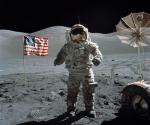 Apollo 17: Last on the Moon
17.12.2005
In December of 1972, Apollo 17 astronauts Eugene Cernan and Harrison Schmitt spent about 75 hours on the Moon, in the Taurus-Littrow valley, while colleague Ronald Evans orbited overhead. Near the beginning of their...
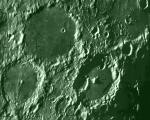 Hubble Resolves Expiration Date For Green Cheese Moon
1.04.2006
Using the new camera on the Hubble Space Telescope, astronomers have been able to confirm that the Moon is made of green cheese. The telling clue was the resolution of a marked date after which the Moon may go bad.
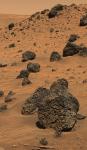 Volcanic Bumpy Boulder on Mars
15.05.2006
What created this unusually textured rock on Mars? Most probably: a volcano. Dubbed Bumpy Boulder, the strange stone measuring just under a half-meter high was found by the robotic Spirit rover currently rolling across Mars.
 The Equal Night
23.09.2007
Today, the Sun crosses the celestial equator heading south at 0951 UT. Known as the equinox, the astronomical event marks the first day of autumn in the northern hemisphere and spring in the south.
 Layers in Aureum Chaos
4.04.2008
At first glance these undulating shapes in shades of blue might look like waves on an ocean. Seen here in a false-color image from the Mars Reconnaissance Orbiter's HiRISE camera, they are actually layered rock outcrops found in Aureum Chaos.
|
January February March April May June July August September October |
|||||||||||||||||||||||||||||||||||||||||||||||||